A Quarter Century with Buffy

It’s always the anniversary of something – we can’t help marking the passage of time, noting that this or that happened sooo long ago and that we, therefore must now be old.  Just a few months ago, coinciding with the lead up to the new Scream movie, I ran into countless reassessments of the original, then hitting its 25th anniversary. I remember seeing it in the cinema, home for Christmas break my first year of college (somehow I seemed to be the only person in a packed house who thought it was funny – the guys I was with were all disappointed it wasn’t scarier), and to think that was a quarter of a century ago is, what, humbling, perhaps? But we’re not looking at Scream today (though I do think it’s great and I did rather enjoy the most recent outing) – it’s recently been brought to my attention that something else just had its 25th anniversary back in March, something of which I became such an obsessive fan that I feel behooved to mark the occasion. So today, let’s have a look back at a TV series, Buffy the Vampire Slayer.

This is the first time I’m writing about TV here and it is a bit daunting. It’s one thing to write about a 2 hour movie, but where do you start with something that’s over 100 hours long? I think that short of rebranding my entire blog, I can only approach it as personally as possible, try to approach why I responded to it as strongly as I did, and look at where it connects with horror for me, as that is ultimately what this blog is about.

How I Came To It

Though Buffy the Vampire Slayer (Hereinafter, BtVS) premiered in March of 1997, I came to the party much later. I had really liked the poorly received 1992 film (it was worth it for Paul Reubens’s death scene alone) and when the show first came out I thought it looked nothing like the film I’d so enjoyed and just wrote it off as some stupid TV thing that wasn’t worth my time. I was also in my first year of college and really too busy to commit to a weekly serial.

Five years later, I was out of school and newly relocated to Chicago where I shared an apartment with a good friend, thanks to whom I finally reappraised the show. But I must say, on reintroduction, I was not much more charitable than I had been back in 1997.  I remember one Sunday night, I’d come home from a party with some friends and my roommate was watching TV. I asked him what it was, and when he said “Buffy the Vampire Slayer,” I kind of laughed and went to my room to crash. The next week, I’d again been out with some friends and when I came home, I once more asked what he was watching and when he told me the same thing, I was like “Again? Ok, I’m going to bed.”  Finally, one week later, when I came home on Sunday night and he was watching the show, I gave in, sat down and started watching too, starting to pester him with questions about who everyone was and what was going on. By the end of that episode, I was hooked.

At that point, on Sunday nights, there were episodes from the end of Season 3. On Saturday afternoons, there were episodes from late in Season 4. When either of these would hit the end of Season 5, it would loop back around to the beginning of the series. Finally, on Tuesday nights, new episodes from Season 6 aired. This still being an era of VHS, I was taping all of them and working my way through three different points of the timeline simultaneously. Everything was spoiled in a way, but it was also an interesting, engrossing kind of immersion. And soon, the DVD sets started coming out, so when my roommate started buying them (he had a computer with a dvd player), I finally watched the beginning. By the middle of the summer, I’d caught up and was waiting with bated breath for the 7th and final season.

What Hooked Me?

In the beginning, I’m sure it was a combination of the wittiness of the dialogue and the scale of the plotting that got my attention, but it wasn’t long before I’d really come to love the characters. On top of that, there was an ambition to some of the filming and a richness of themes and ideas that simply went beyond what I had expected from a silly teen superhero-horror melodrama.

I loved the scope of the storytelling. With a relatively limited budget, and some admittedly shaky CGI, we have huge tales of ancient vampires vying for power, a Hellmouth waiting to spew forth all manner of eldritch evil, returning earth to its original, monstrous state, a chaos god who will rend reality to go home, a demon called forth to swallow the world, and a really affable politician who really just wants to be a big snake. Standing against it all, we have one girl who never volunteered for this and her not terribly cool friends, all of whom have to deal with these grand conflicts while enduring the countless normal trials of high school.

Buffy the character, on one level, embodies the most standard reluctant hero tropes, but situating all of that in the bubbly blonde girl, constantly underestimated, forever discounted, sometimes even by herself, gives it a freshness, a lightness. She is called on, time and time again to sacrifice herself (she dies – twice), her lover, and her family – in many ways she is a classic tragic hero – and yet so much of her journey is finding the way to do all of that and still live, laugh, love – staying connected to the world, to friends, to community and thus, not to succumb to the role (in fact, in the series finale, the group manages to share Buffy’s power with countless other young women – thus both empowering that community and making her no longer the sole lonely hero – to quote Giles, “the subtext is rapidly becoming text”). As an overarching theme, it’s hard to resist.

Essential to this larger story then of course, are the friends and lovers and family that ground her, and they are also what make the show so addictive. Buffy is surrounded by, at least in the beginning, “normal” people – without power, without social position (though some of them certainly become quite powerful by the end), just a shy bookish wallflower, a kinda goofy guy lacking direction, a nebbishy librarian, and a single mother trying to get a fresh start. It’s easy to know them, to love them, and written in such a pleasant and piquant manner, you want to come back each week to hang out with them. We may not all be tortured heroes, doomed to tragic romance and burdened with terrible purpose, but a central ethos of the show is that it does take a village.

Another hook here is the show’s format, one which now may seem old fashioned, but may have helped usher in the current age of prestige television. These days, shows are made to be consumed in a weekend – a season of about ten episodes, each one ending on a cliffhanger so you have to start the next to let the story continue. But around the time that BtVS came out, procedurals were pretty much the order of the day. For a show that aired once a week over about 22 weeks, it was pretty standard to make each one a standalone story that didn’t require audiences to have seen everything that had come before (there were of course exceptions to this – soap operas and weekly dramas, but I do think it was the dominant model). What BtVS managed to do, when it was at its best, was to really thread the needle.

Every episode could be a “monster of the week,” but woven through these over the course of the season, there were also large narrative arcs – with seeds planted early which could come to fruition later and set off a larger conflict/development/threat that would really deliver a powerful dramatic climax to the story each year. This arc was propelled by the characters and it would see them undergo real changes. It was really satisfying plotting. At the same time, the episodic, procedural nature kept things fresh and let characters just be together and interact while getting the necessary work done. They had room to breathe, to have downtime, to be people, people with whom it was easy to identify.

On that identification, the sixth season, the one with new episodes that year I got hooked, took a real turn from those before it. Previously, there had always been some “Big Bad,” the main villain of the season who ultimately Buffy and the gang would have to thwart in their evil plans. This might be a really old master vampire (the Master) or it might be a crazy god (Glory), but in this season, that was turned on its head. Ostensibly, the main villain was a triumvirate of toxic, geeky guys, but that was a red herring. Really, the “Big Bad” that year was just life. All of the main characters at that point were out of school, their parents were out of the picture, and life was just kicking their butts. Engagements fell through. There were substance abuse issues (magic abuse, actually, but still). Everyone had to be responsible for themselves and make ends meet, and it was hard, and people were just self-destructing.  I can’t say that I had any particular problems that year; in fact, life was pretty good. But it was my first year out of college and I could really feel for these characters who had accomplished so much, but who were now struggling to live in the real world, having lost the structure of childhood, school, and family. It was one way that it really felt personal.

Is It Horror?

Though it may contain myriad monsters (vampires, of course, but also werewolves, witches, mummies, ghosts, zombies, demons, giant insects, ventriloquist dummies, fish-people, cultists, tentacled otherworldly mind crushing beings; the list goes on), and there are even a couple of episodes that approach scary (Hush; Helpless; Killed by Death; Same Time, Same Place; among others), it’s hard to say it’s really a horror show. But it is rooted in horror (see the beasties enumerated above) and it does something that horror does; using the fantastical, the supernatural, it talks about real, emotional, social, political, psychological experiences, and specifically, fears.  Beginning with the central metaphor that ‘high school can be hell,’ it brings that to life more effectively by having Xander, for example, get possessed by a hyena and eat a cute pig, than it would be able to as a straight teen drama. Sometimes it can be a bit ham-fisted (oh, Beer Bad…), but most of the time, there is a positive feedback loop between the superhero-horror story and the difficult life experience represented by it.

Probably the prime example of this is when Angel, Buffy’s vampire love interest for the first couple seasons, literally loses his soul after they sleep together for the first time (due to an oddly conceived “gypsy curse”).  He’d seemed like such a nice guy and suddenly he’s this cold, sociopathic monster. An event like that could exist on a “realistic” teen drama, but it is elevated beyond the melodramatic by playing out on this nigh mythic level, part of a tale of magic and revenge, and love and betrayal, of literally life and death, with the world at stake; and at the same time, that epic storyline benefits so greatly from the emotion that comes from this familiar, realistic, identifiable experience that any teenager could have.

Perhaps due in part to the extent to which BtVS and Horror in general both lean into metaphor, an interesting trait they share is that they are both very much analyzed and written about. That first summer that I’d really gotten into BtVS, I stumbled upon what was for me at the time, a really novel book, “Fighting the Forces: What’s at Stake in Buffy the Vampire Slayer.” This was a multi-disciplinary series of academic essays, all focused on the TV show I’d just gotten obsessed with, and I ate it up. I’d recently finished grad school, in Performance Studies (focused on performance theory and, in an anthropological sense, using performance as a lens to view human activity, and vice versa). But I’d not yet encountered serious scholarly investigation of a pop culture artifact such as this, especially given how hard I had fallen for it. (This may now be hard to find, but Slayage: the International Journal of Buffy+ Studies is still active and all publications are free on their website.)

After this first book, I found a few others, and I’m not certain, but I think there’s a pretty good chance that it was going down this rabbit hole that led me to scholarly works on horror (Noel Carroll, Carol J. Clover, Barbara Creed, etc.), and it was discovering these readings of horror texts that really changed my relationship to the genre. This was possibly when I really became a fan. I didn’t just enjoy a good scary movie occasionally, but now I was really thinking about the genre, considering its artistic and philosophical value in a wholly new way. In horror I found another collection of work that people readily scoff at and put down, but which is rich in meaning, in experience, and the appreciation of which invites interrogation. So, it is possible that I have Buffy to thank for that.

What About Joss?

So a certain name has been notably absent in my discussion thus far – Joss Whedon, the creator and show runner of not only BtVS, but also its spinoff show Angel and a few other fantastical fan favorites. In recent years, unsavory details have come to light about how he ran the show and what the dynamics were like behind the scenes. It hasn’t quite risen to #metoo levels, but it seems he sleazily used his position to secure romantic relationships with employees and was abusive and cruel, particularly to certain actresses and female staffers. This is more than a little disheartening as the show always had an outwardly feminist self-presentation and his voice is just all over the show. That warm wittiness, the dramatic choices made for characters and the larger narratives – it feels like him. Having watched 5 different series that he created and a few films, his voice is clear. Many have said recently that it’s important to focus on the fact that many, many people are involved in making a TV show and have thus tried to minimize his influence on it all, but I think that’s disingenuous. From what I’ve read, this really was an auteur situation, even with a large team working beneath him.

I think that while of course the show stands on its own and holds up regardless of what details have come out about its creator, now when watching it and hearing dialogue that is so clearly in his voice, a pall is cast, a reminder of the ugliness that has gone into this artwork I love – and it can leave a sour taste in the mouth. And yet, I do still love it. And there is that bad taste. Both things can be true.

We live in an era when we are called on to hold ourselves accountable for enjoying the work of people whom we’ve learned bad things about, and thus to stop enjoying that work. To some extent, I see the value in not giving my money, which I work for, to someone who is actively using it to do something I disagree with. But if I were to decide that I shouldn’t watch this show anymore, a show that I have found such joy and comfort and excitement in, who benefits and who is harmed? Is anyone affected but me? Probably not. Some may feel that the bad taste makes it impossible to appreciate the material as they had once done, and I can understand that feeling (perhaps, I am able to stomach it only because I haven’t had to directly put up with certain things in my life – and that is a position of privilege), but for myself, as I attempt to navigate an ethical life, I think I’ll just ride that train of cognitive dissonance. The world is complicated. Twas ever thus.

Plus, I’ve already got all the dvds and I’m not giving them back.  

50 Silly Poems about 50 Scary Movies from the Last 50 Years

So, this is my 50th post here. Huzzah! Having started in September, it has now been half a year of publishing once or twice a week and I feel pretty good about what I’ve been writing. I don’t know how much I’ve necessarily built an audience, but Google tells me that there is some traffic, so someone must be coming to read these things. Unless it’s just bots, and let’s assume it isn’t.

Anyway, to mark the occasion, I wanted to do something a bit different and have a laugh with a little idea that ended up being a sizable project. As a celebratory game/writing challenge, I’ve composed 50 short, silly, somewhat Seussian poems, describing a movie a year for the last 50 years.  These are not deep cuts – I’m not looking to really stump the reader, but just to offer a bit of fun in identifying the cinematic inspiration for each verse (there will be a key at the bottom). I hope you enjoy – I rather tickled myself putting them together. And I hope you keep coming back for the next 50 posts.

The 70s

1973

  • On an Island in Scotland, just short of May Day,
  • A fool Kingsman and virgin did willfully stray.
  • But when things got too hot, he could be heard to moan.
  • They were dancing outside, but he died all alone.

1974

  • When the door slams, it’s over. You need not ask why.
  • On meat hooks, with hammers – your friends will all die.
  • You will run through the woods and then scream your lungs raw
  • Till you’re covered in blood, mad. He raises his saw.

1975

  • Our Mayor wants us to stay open all summer,
  • Though dead kids can really be kind of a bummer.
  • These big yellow barrels do not keep afloat.
  • We are going to need a much, much bigger boat.

1976

  • If your mom sees your dress ‘fore you go to the prom,
  • You’ll get locked in the closet for sinful aplomb.
  • The pig’s blood in the bucket is going to fall.
  • Both gym teacher and bullies, you will burn them all.

1977

  • Count the steps late at night, all these witches suspicious,
  • Razor wire filling rooms and a guide dog most vicious.
  • Goblin’s score makes your ears ring with discordant harmn’y.
  • You may regret your choice: study’ng ballet in Germn’y.

1978

  • Annie’s killed in her car. Lynda’s totally strangled;
  • The poor dog’s neck is snapped. On a wall, Bob is dangled.
  • Doctor Loomis sees Lonnie and gives him a fright.
  • Laurie faces the Boogieman, Halloween night.

1979

  • An additional guest comes aboard the Nostromo,
  • It’s well lubed proboscis extending in slo-mo.
  • Though the grappling hook does get stuck in the door,
  • We see Ripley and Jonesy in stasis once more.

The 80s

1980

  • Down at Camp Crystal Lake, also known as “Camp Blood,”
  • Someone’s stalking the counselors, boots caked in mud.
  • Most of the teenagers, of course, end up dead,
  • But Alice with a blade, in the end, takes her head.

1981

  • All the roses are red and the violets are blue.
  • Harry Warden, it seems, he is killing anew.
  • Candy boxes with hearts and Mabel in a dryer-
  • Life in a small mining town can be dire.

1982

  • Norwegians hunt dogs in their Antarctic chopper.
  • A spider legged head is a real big show stopper.
  • All the rest of the base, by something, get got.
  • Are MacReady and Childs really human or not?

1983

  • Max Renn, seeking content for CIVIC TV
  • Discovers a cult/eye glass/arms company.
  • Brainwashed by a cassette in chest opened fresh,
  • He blows out his brains – Long live the new flesh!

1984

  • The sins of the fathers have come back a’haunting
  • The dreams of the children. To sleep now is daunting.
  • Up the wall, Tina’s dragged by an unseen assailant.
  • So Nancy, into survival, must grow more battailant.  (it’s a word – thanks thesaurus)

1985

  • The third in a series of dead folks still walking –
  • The soldiers and scientists each other mocking.
  • Rhodes gets his comeuppance, Bub shoots and salutes.
  • Let’s fly to an island for tropical fruits.

1986

  • Seymour gave Twoey plant food, but it wanted blood,
  • Had a chance to lift himself up out of the mud,
  • But the murder and feedings were not his forté.
  • In the director’s cut, he becomes an entrée.

1987

  • A carton of maggots, a bottle of blood –
  • Nanook’s a good doggie and Sam is his bud.
  • The Frog brother’s give him Destroy all Vampires!
  • His grampa’s stuffed beavers don’t get many buyers.

1988

  • Gets her son a “Good Guy” doll from a homeless toy seller,
  • Not knowing a killer in this doll’s a dweller.
  • She may blow him away with a pistol attack,
  • “Ade due damballa!” He always comes back.

1989

  • Heed the warning of th’jogger who’s hit by a truck:
  • Resurrecting the dead’s gonna bring you bad luck.
  • If you bring back the cat, it’s a real bad trend setter.
  • Just trust me, ayup, sometimes dead is better.

The 90s

1990

  • A Vietnam vet eyeing disturbing sights,
  • Maybe drugged by the army to do well in fights.
  • But his chiropractor quotes Meister Eckhart –
  • These angels, not devils, some peace do impart.

1991

  • Finding cannibal children who live in the walls,
  • Fool fights “Daddy” (and “Mommy,” as his sister he calls).
  • Gold enough for the rent and for mom’s operation –
  • It’s kind of a fable of gentrification.

1992

  • “Be my victim,” he sighs while he’s scrapping his hook,
  • Drawn to her as belief Helen’s research has shook.
  • Their mouths close together, his quite full of bees.
  • In the end, they are only just ash on the breeze.

1993

  • On motorbikes sex acts are to be deterred,
  • But when your girlfriend is dead, Trioxin’s the word.
  • With long spikes, nails, and glass, Julie’s pierced and adorned,
  • But the young undead lovers are tragically burned.

1994

  • A new meta spin on a dream master classic,
  • Placating the force that inspired the past flick:
  • So now Robert is painting, and Wes writes a script.
  • Into Heather’s real life, this night terror has slipped.

1995

  • In the Mojave desert, the Puritan’s cult
  • Try to sacrifice someone but flub the result.
  • Now, thirteen years later, D’Amour gets a case.
  • Dorothea’s dead husband puts Nix in his place.

1996

  • Poor Bonnie has burn scars all over her person.
  • Her bully’s blonde hairdo, Rochelle seeks to worsen.
  • “We are the weirdo’s,” Nancy tells the bus driver.
  • Though Sarah’s tried suicide, she’s the survivor.

1997

  • A Gainesville attorney who has never lost
  • Will do what he has to no matter the cost.
  • Though his temptations lead him t’the edge of perdition,
  • He seemingly foils John Milton’s ambition.

1998

  • John Stewart succumbs to the pen in his eye.
  • To prove yourself human, take this and get high.
  • Only run when you’re chased, dehydrate the queen squid.
  • In the end, you’ll give in to conformity, kid.

1999

  • In the woods of north Burkittsville, there’s some folklore.
  • Kids wanting to film there are seen nevermore.
  • While you may be tempted to be a map scorner,
  • If you do, you might find yourself stood in the corner.

The 2000’s

2000

  • Metaphorical menses, Canadian lupine –
  • These two teen sisters now face a lunar length deadline.
  • They used to do art projects morbid and gory,
  • But do Ginger and Brigette deserve their sad story?

2001

  • A live bomb in the courtyard, dead boy in the tank.
  • Hide the gold with the orphans and not in the bank.
  • The ghost blood floating upward, Jacinto’s the cause.
  • He will get what he’s due, for the killer he was.  

2002

  • These are real angry monkeys – let’s not set them free,
  • Or from the infected we’ll all have to flee.
  • To survive, Jim will have to succumb to his rage.
  • To kill rapey soldiers, free the one in the cage.

2003

  • It’s New French Extremity – big third act twist.
  • This guest with a straight razor wants to be kissed.
  • She will kill your whole family and more in the end,
  • While she still really thinks that she is your best friend.

2004

  • Diet Coke and an ice cream to start the day right,
  • Then get Liz and your mother before taking flight.
  • At the Winchester, wait out this plague of the dead
  • And then finally hang out with Ed in the shed.

2005

  • A tragic car accident – one ill-placed pipe.
  • Will this cave dive help Sarah or is it just hype?
  • Juno’s not to be trusted – see, Beth has her chain.
  • Out of blood, Sarah rises to bring on the pain.

2006

  • Mockumentary horror: the dawn of a slasher
  • Who will get his head crushed in an apple juice masher.
  • That she’s really the final girl is a surprise.
  • After filming his exploits, she did not surmise.

2007

  • Respect the traditions the night of Samhain
  • Lest your cervical vertebrae be sliced in twain.
  • Leave eight Jack o’ Lanterns to honor the dead
  • Or the ghosts of the children your hot blood will shed.

2008

  • Just a lonely young Swede, who is bullied by all,
  • Tap a message in Morse code on your bedroom wall.
  • Your alluring new neighbor of uncertain gender
  • Is a ruthless vampire, both brutal and tender.

2009

  • Velvet ribbons adorning her wrists and her neck,
  • With threats to keep worried new siblings in check.
  • Piano playing’s impressive – her painting’s real wild,
  • But obsession and wrath are the strengths of this child.

The 2010s

2010

  • To their fix-er-up cabin come two backwoods buds.
  • Due to misunderstanding, the gore comes in floods.
  • College students keep killing themselves for no reason.
  • It seems nitwits are something they need expertise in.

2011

  • The harbinger warns to turn back on your path.
  • At this rustic cottage awaits a bloodbath.
  • It is all orchestrated to keep evil packed in.
  • Just one piece of advice: You should not read the Latin!

2012

  • A sound engineer who could not be more British
  • Around these Italians gets really quite skittish.
  • Watermelons are smashed and a cabbage is stabbed.
  • Out of their nest, chicks are brutally grabbed.

2013

  • On just one night a year, all the laws are suspended.
  • The New Founding Fathers, all crime have commended.
  • Tightly locked in your castle to wait the night through,
  • If your neighbors don’t like you, you’ll sure get a clue.

2014

  • Ling’ring grief for a husband, a difficult brat –
  • A new picture book summons a spook in a hat.
  • Try as hard as you like, he will not go away,
  • But he’ll oddly become a queer icon one day.

2015

  • Post expulsion by Puritans with a black goat,
  • Keep your eye on the baby, or his blood will broom coat.
  • Coughing up a whole apple, give milk to a crow –
  • Wouldst thou like taste of butter? Sign here, up you go.

2016

  • Explore under the surface – there’s hist’ry of crimes.
  • Invested with power to avenge Salem times.
  • Neither father nor son really at all to blame –
  • That their end is so gruesome is rather a shame.

2017

  • Quite uncomfortable visiting whites over-friendly,
  • Brain-swap-slavery scheme and a family most deadly.
  • Block the sunken place out, cotton picked from your seat –
  • Your friend always says TSA can’t be beat.

2018

  • Susie lives in Berlin now – yes that includes her.
  • Be the hands of the troupe – the new Volk lead dancer.
  • The dark drive to power, the ghosts of fascism –
  • Which mother to follow? A company schism.

2019

  • Depressed sister chose family asphyxiation.
  • This could be an odd time for a Nordic vacation.
  • You should warn your bad boyfriend to try more to care,
  • Or he’s going to wind up inside of a bear.

The 2020s

2020

  • Get stabbed by a psycho and th’next day you’ll see
  • What it’s like to be fright’ning and stand while you pee.
  • Try convincing your friends that you don’t mean to maim
  • While the killer with your face tries doing the same.

2021

  • Disappear if you want – break your nose, cut your hair.
  • Your adoptive dad grooves when he hears She’s not there.
  • And though many a needle into ear is shoved,
  • It’s really a story about being loved.

2022

  • A reflexive re-quel, about what it is,
  • Discussing “the rules” of the horror film biz –
  • The legacy trio returns to Woodsboro
  • To fight killers in masks; it’s a story they know.

Ok, yeesh. Poems are hard work. I hope you’ve had some fun – there’s a key after the pic.

KEY: 1973 – The Wicker Man; 1974 – The Texas Chainsaw Massacre; 1975 – Jaws; 1976 – Carrie; 1977 – Suspiria; 1978 – Halloween; 1979 – Alien; 1980 – Friday the 13th; 1981 – My Bloody Valentine; 1982 – The Thing; 1983 – Videodrome; 1984 – A Nightmare on Elm Street; 1985 – Day of the Dead; 1986 – Little Shop pf Horrors; 1987 – The Lost Boys; 1988 – Child’s Play; 1989 – Pet Sematary; 1990 – Jacob’s Ladder; 1991 – The People Under the Stairs; 1992 – Candyman; 1993 – Return of the Living Dead III; 1994 – Wes Craven’s New Nightmare; 1995 – Lord of Illusions; 1996 – The Craft; 1997 – The Devil’s Advocate; 1998 – The Faculty; 1999 – The Blair Witch Project; 2000 – Ginger Snaps; 2001 – The Devil’s Backbone; 2002 – 28 Days Later; 2003 – High Tension; 2004 – Shaun of the Dead; 2005 – The Descent; 2006 – Behind the Mask; 2007 – Trick ‘r Treat; 2008 – Let the Right One In; 2009 – Orphan; 2010 – Tucker and Dale vs. Evil; 2011 – The Cabin in the Woods; 2012 – Berberian Sound Studio; 2013 – The Purge; 2014 – The Babadook; 2015 – The VVitch; 2016 – The Autopsy of Jane Doe; 2017 – Get Out; 2018 – Suspiria; 2019 – Midsommar; 2020 – Freaky; 2021 – Titane; 2022 – Scream

An Exorcism Exception

So, while I love a wide variety of horror content across all sub-genres and media, one kind of story tends to rub me the wrong way: the possession-exorcism (though just last week, I did write about an interesting take on the subject). Sure – they can be really creepy, there are a couple of classic examples that are really great, well made movies, and it is a very, very popular theme, but it almost always turns me off. They often leave an aftertaste of proselytization, seemingly advertisements for the Church, Catholic or otherwise (in recent years, the Warrens led Conjuring films have been notably unpleasant examples, though they primarily present as hauntings).

Now, there are other kinds of films dealing with demonic or diabolical elements or religious imagery that don’t do this. I think it is because, while they may contain religious elements, they are not about (or even particularly in support of) religion the way an exorcism film can be. Van Helsing holding up a cross to ward off a bride of Dracula I can accept as a simple trope of Vampire fiction without feeling like it’s supposed to teach me to let Christ into my heart. Films can directly feature the Devil as an antagonist, but somehow Pacino in The Devil’s Advocate, reveling in his bombast, or Black Philip in The VVitch asking if Tomasin wouldst like to live deliciously, don’t make me feel uncomfortable, as if I’d made the mistake of inviting in two polite, well-dressed chaps who want to give me the good news. I mean, sure, I generally want horror to make me uncomfortable – but not that way.

So what is it about this story? Why does it have this particular effect on me? On one level, a possession film is so often about someone in denial about the “truth” – that radical evil is real and that we are helpless against it without faith, specifically faith in “the Lord.” The story is all about this horrific realization on the part of a protagonist, whether the mother of the demoniac in question or a priest who has lost his faith and must regain it to prevail (both from the Exorcist), who only after accepting this knowledge has a chance of casting out the evil presence.  Scientific methods may be used to try to diagnose the problem, but they will all fail until the only remaining solution is that of the holy man with a cross. And oddly enough, I feel the filmmakers often may not even intend such a message or experience – they are just trying to tell a scary story and are thus leaning on certain generic conventions, but in so doing, the resultant film can have the vibe of a church basement Halloween Hell House – where they are having great fun creating horrible things (because that is, of course, fun), but it is all in service of scaring the visiting kids away from sin.

Maybe I’m overstating it, but it’s the feeling I get personally.

So if I’m so put off by possession narratives, why am I even writing about them? Well, because I have an exception here – a book that takes the story in a really different direction and delivers a totally distinctive tone. And sometimes, when you find a really good book, you just want to go door to door and tell people about it.

My Best Friend’s Exorcism (2016) by Grady Hendrix

First, I have to say – it is very hard to impossible to really get into what I think is so great about this novel without explicitly discussing the ending, and I feel it features a turn that really can be spoiled. I’ll give a fresh warning before I get to that part and if you think you might like to read the book, do yourself a favor and go pick it up before finishing this text. It’s a really quick read – the first time I did so, I tore through it in one sitting on a flight from Warsaw to NYC, only pausing for meal and bathroom breaks.  

Ok, so this is the story of Abby, whose best friend, Gretchen, gets possessed by a demon, which in turn, must be exorcised. By the end it is. Hooray. Simple, right? But where it is special is in the relationships between the girls.

We start when they first become friends on Abby’s tenth birthday party: an E.T. themed event at the local roller rink (spanning the years 1982-1988, 80s pop culture looms large in this story, very much the air that these friends breath, the idiom they speak – sometimes in shouting misheard Phil Collins lyrics, sometimes in playing Madonna dress up and getting in trouble with one religious mother who does not approve of the material girl, or in this case, just needing E.T. everything). Gretchen, the new girl in class, is the only one to show up, rather than going to a much fancier party being thrown by another kid she doesn’t know; somehow kismet strikes and they really click, thus starting a lifelong friendship. The book takes its time with this utterly non-scary but equally foundational episode, and then carries on taking its time with the next 5 years of the girls’ lives and friendship. I was surprised on re-reading it to find that this only makes up about 50 pages of the book – it had felt like so much more; really getting the connection between them, from running jokes to secrets shared, to embarrassing details of parents’ lives uncovered.

Then, when they’re 16, Gretchen gets possessed and everything goes wrong. The horror elements come quick and hard in this middle stretch: ominous, shadowy figures in the woods, owls bloodily slamming into windows, the feeling of a hand on the neck when no one’s there, creepy voices on the phone at night, beloved pets murdered, white fleshy worm things vomited out. Hendrix pulls no punches in delivering revulsion and shock. But he manages this while at the same time maintaining a somewhat blackly comic tone (I’ve read comparisons to Heathers). But the worst thing is in no way supernatural, but rather just the simple horror of your closest friend changing, betraying your secrets, becoming cruel, becoming someone you can’t trust, someone who hurts people, who is downright evil, and whom you somehow still love. Friendship and love necessarily entail vulnerability, and Abby has no walls to guard her from Gretchen’s malice. She doesn’t need much convincing to believe her friend is possessed by a demon.

So she finds herself an exorcist and now’s a good time to go pick up the book if you think you might like to read it. I’ll wait.

Ok, so here is where Hendrix’s book really distinguishes itself from the exorcism pack (and I’ll describe it even though you hopefully just finished reading it). Abby finds an exorcist, Brother Lemon – an earnestly absurd Christian weightlifter with whom she kidnaps, in order to save, her friend. In the process of the exorcism, the demonic presence reveals itself and we get all the typical supernatural spookiness and fluids. Now, Lemon knows all the steps but has never done this before and comes close to killing Gretchen before Abby stops him. He leaves in disgrace and Abby, alone with her friend and something else, has to finish the job.

She starts by following his playbook, reciting prayers and such. It’s kind of working, but she doesn’t believe these words. They are empty symbols for her, and finally, unable to abandon her friend, determined to go down with her if she has to, she finds the words that are true: the misremembered lyrics of a Go-Gos song that played at her 10th birthday party, a litany of singers or actors or shows or jokes or games they have watched or told or played together. The power of Christ might not compel this demon to leave, but maybe the power of Phil Collins can. The power of all the little references and memories, things they have loved and laughed over, secrets they have entrusted one another with. These are authentic things. Absurd and silly and seemingly inconsequential, and real. It is an amazing, exciting, moving sequence.

And it manages to make this the rare exorcism that works for me by basing it on something I can actually believe in. Faith may be necessary for the procedure, but faith need not be religious. Abby acts out of faith, not only in her friend, but in the very concept of Friendship, actualizing not only the love between them, but Love, itself: making out of the frivolous detritus of childhood, icons of power. This was the second time I read it and while the middle section of horrible events lost some effect without the element of surprise, the climax landed just as hard as it had the first time, on a plane, trying to both stifle guffaws and ugly crying – cause that’s kind of embarrassing sitting next to a stranger.

Grady Hendrix has been a really enjoyable discovery for me in the last few years. This was the first book of his that I’d read, but since then I’ve worked through the rest of his available output (some are sadly out of print) – covering a range of horror topics, but all with a kind of light touch – not necessarily comedy, but something humanistic and, for lack of a better word, fun. Whether exploring a haunted Ikea in Horrorstör, a Faustian heavy metal parable in We Sold Our Souls, following middle aged housewives hunting the undead in The Southern Book Club’s Guide to Slaying Vampires, or most recently, delving into the life changing trauma of being a survivor in The Final Girl Support Group, he offers interesting and entertaining spins on well-worn ideas, that come alive in character without sacrificing the horror. My Best Friend’s Exorcism is no exception.

Delightfully Flinching in the New Header

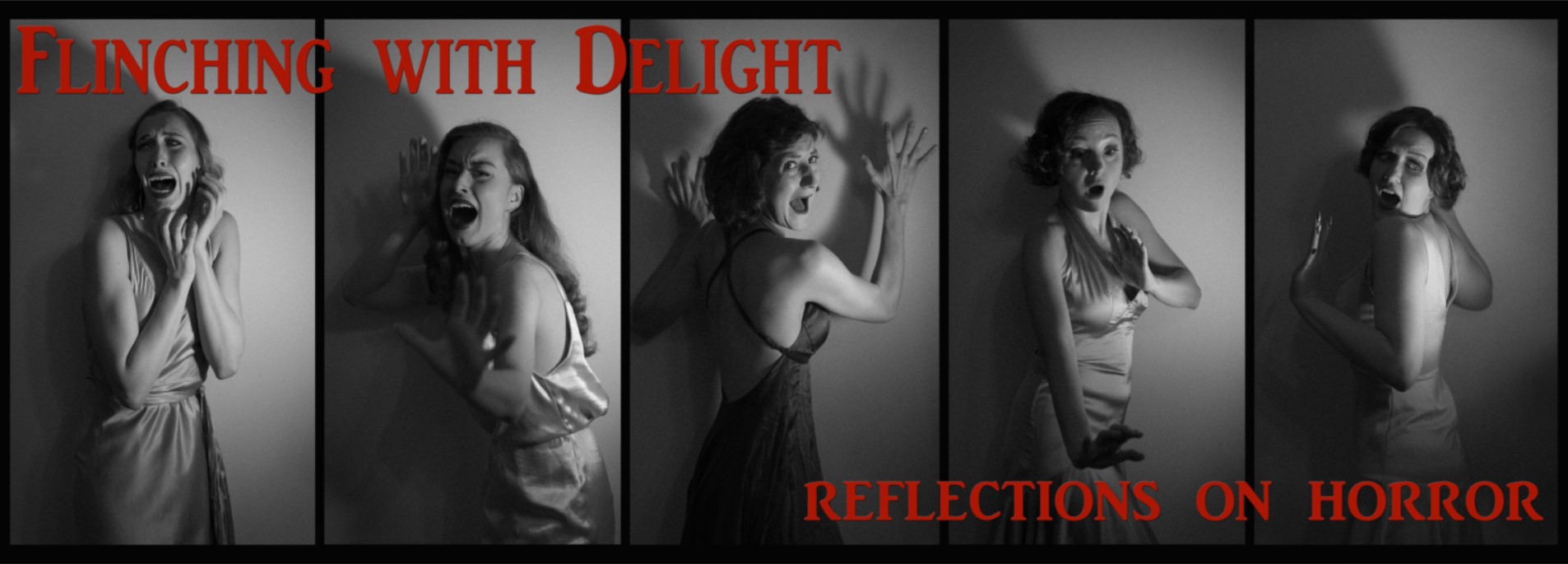
So, this has been in the works for quite some time, and now I’m happy to finally announce a brand-spanking new header for the site.  If you’re on a mobile device, you may not see it, so here it is (with apologies to desktop users for the duplication):

Particular gratitude is due to the photographer, Klaudia Bałazy, and the models, Gabriela, Julia, Ola, Kasia (who also had the idea for the image), and Magda, all of whom I’m happy to collaborate with in La Folie – Retro Cabaret Show. Thanks all – I think it’s pretty groovy!

Photo: Tomasz Wynalazek

The image (at the top of the page – or if you are an e-mail subscriber – click through to check it out) grows out of a cabaret sketch we did for a Halloween performance. The idea of the sketch was to recreate the style of a silent horror film – all women in incongruously elegant gowns (ala The Old Dark House), exploring a creepy old manor by candle light, discovering a shrouded figure, and, fingers trembling, reaching out to reveal his monstrosity (ala Phantom of the Opera), before screaming in a building terror that edges on madness (ala Metropolis) – but funny.

It was a comedy bit after all, and the idea was to both pay homage to the visual sumptuousness of the silent era and to have some fun with the over-the-top-ness of the premise.  One woman shrieking in fear might be scary. Four women, one seemingly straight laced husband, and the hideously deformed creature chasing them all sequentially startling each other like classic Scooby Do shtick and then silently shrieking in alarm was hopefully pretty funny.  

Photo: Tomasz Wynalazek

It was a treat to work on and I think the effect achieved with relatively simple means (LED candles and one technician with a close handheld light source) was stylish, atmospheric, and playful. It is a real pleasure – a delight, you might say – to bring to life even a small idea that really tickles your fancy. And out of it was born a visual concept for this blog that took a few months to finally execute, but with which I’m really happy: five women, in chic dresses, screaming like something out of a classic film.

So, let’s talk about that. Once I finally finished assembling the image, I couldn’t help but notice that gender had been (perhaps inadvertently, but nonetheless, prominently) foregrounded. I mean, it is such a long standing criticism of the genre that it focuses on and fetishizes images of female suffering. Whether or not that critique is totally accurate has been fairly challenged, but perhaps the very fact that I didn’t include any guys – it just wouldn’t have been the iconic look I was after – does imply the persistence of a trend and suggest that it should be discussed.

On one level, this is evident throughout the history of the genre – looking at classic horror cinema from the silent era, the 30s Universal horrors, Val Lewton in the 40s, monster movies of the 50s, up to the slasher boom of the late 70s-80s, and beyond, a woman screaming is just such a central image. For some critics, this is a sign of an inherent misogyny – the viewer is invited to sadistically and vicariously get off on looking from the POV of the masculine threat at his prey. Others perceive a different, but not necessarily less misogynistic, approach – the woman is the endangered protagonist because her gender implies a vulnerability which makes the threat that much scarier – now, vicariously identifying with the female body situates us, the viewers, more as “victims.” Still others defend the trend as pure style or aesthetics (thus opening themselves up to new criticisms of objectification) – Dario Argento once famously said, “I like women, especially beautiful ones…I would much rather watch them being murdered than an ugly girl or man.”

And others have read this totally differently. You could certainly take the degree to which the woman is in the middle of the horror narrative as positive; regardless of the reasons for it, compared to the majority of other genres, horror’s number of female protagonists (final girls, scream queens, imperiled ingénues, or what have you) is effectively quite progressive. Sure – women might be centered so that the protagonist can display “weak” traits that are unfairly coded as feminine (fear, hysteria, physical weakness). I’m pretty sure I remember Carol Clover describing how, in the figure of the “final girl,” the audience can have its cake and eat it too, identifying both with her feminized fear and with the moment when she stands up and fights back, taking on what are read as masculinized characteristics (and, of course, striking out with some penetrative sharp phallic object – Freud is all over this stuff).

But I think what this all really speaks to is how unrealistic the “strong” traits coded as masculine are.  In a moment of real crisis, I expect most of us are more likely to freeze up, be incapable of acting, and hide in a corner weeping until ugly death comes for us.  Exceptionally few would have the chutzpa to really rise as some hyper-masculine action star and lay waste to the threat, whatever it might be. I think these maligned traits, supposedly feminine, may actually be just the most realistic traits for any character to have. Facing true horror, honestly, who wouldn’t scream?

A striking example here is Barbara from Night of the Living Dead. The presentation of her character has oft been denounced as unfair to women. Of all of the figures in the seminal zombie classic, she is particularly useless, spending much of the film either hysterically freaking out or in a state of near catatonia. George Romero even took the criticism to heart and in the 1990 remake, which he wrote but didn’t direct, she was a total badass to make up for it. That’s fine – it’s actually a kind of good movie in its own right – but I think Barbara from the original rings so true. Here’s this young woman who sees her brother killed in front of her, gets chased by some weird madman to a house in the middle of nowhere, and comes to realize that the dead are rising and eating the flesh of the living! If there’s a more appropriate time to snap under the pressure, I can’t think of one and I think that put in her position, more people (men and women) would behave exactly as she does.

So, at the end of the day, sure – it’s impossible to deny that there are social inequities associated with the classic image of the screaming woman, but I think sometimes they are more linked with expectations that unjustly persist in society than with what the picture itself necessarily communicates. For my part, I really love the new image we’ve created here. I think it strikes a balance of terror and playfulness, with a classic cool vibe (and the gender focus is a part of that), celebrating the films themselves and reveling in the horror, while calling for some degree of reflexivity – some work of interpretation. Life is endlessly complicated and we are all probably ultimately unknowable to ourselves, so anything that suggests we take a moment for consideration is worthwhile.

Photo: Tomasz Wynalazek

In our sketch, it was finally one of the girls who enters into the house, finds the square jawed, masculine, husband type tied up in the basement, screaming for his life and saves him, before revealing that she’s actually a vampire and biting his throat. The point is that sometimes, you can be all things, having and eating your cake, enjoying the repeating image of the screaming woman and inverting that image to have one save the day, and inverting it once again to make her the monster.  All of the aforementioned perspectives can be simultaneously correct – even when they contradict each other. Maybe especially when they do.