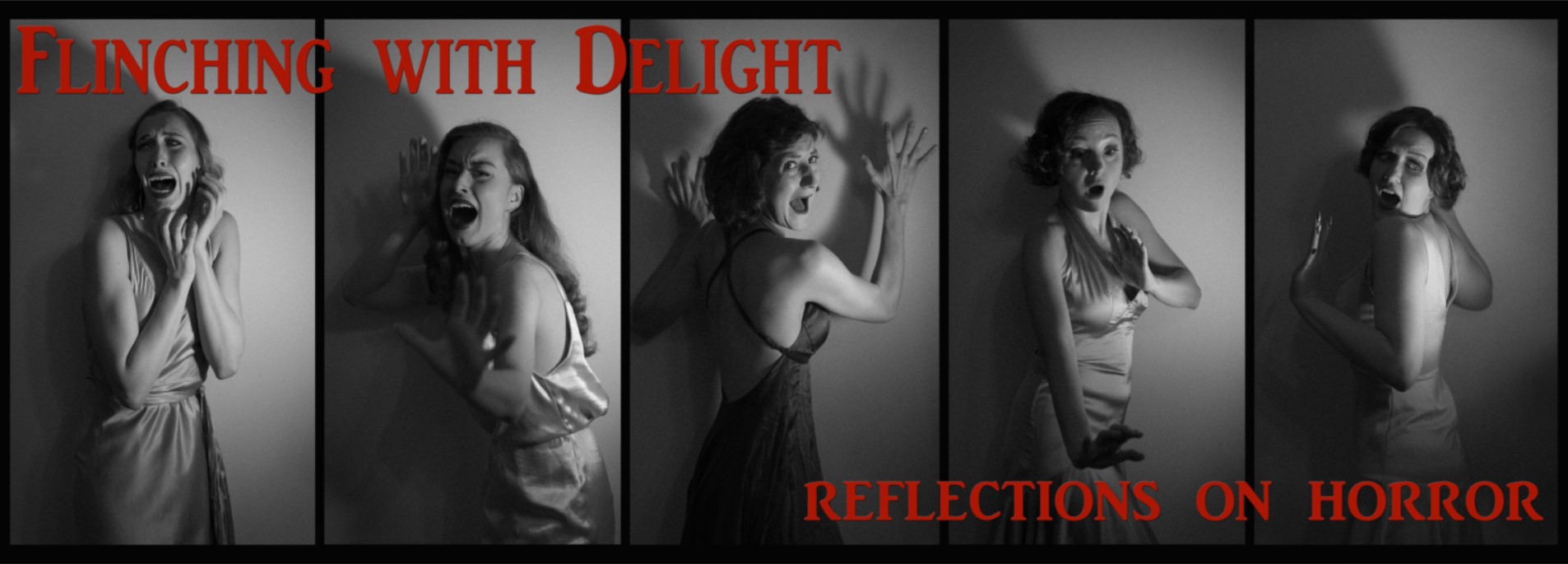
Delightfully Flinching in the New Header

So, this has been in the works for quite some time, and now I’m happy to finally announce a brand-spanking new header for the site.  If you’re on a mobile device, you may not see it, so here it is (with apologies to desktop users for the duplication):

Particular gratitude is due to the photographer, Klaudia Bałazy, and the models, Gabriela, Julia, Ola, Kasia (who also had the idea for the image), and Magda, all of whom I’m happy to collaborate with in La Folie – Retro Cabaret Show. Thanks all – I think it’s pretty groovy!

Photo: Tomasz Wynalazek

The image (at the top of the page – or if you are an e-mail subscriber – click through to check it out) grows out of a cabaret sketch we did for a Halloween performance. The idea of the sketch was to recreate the style of a silent horror film – all women in incongruously elegant gowns (ala The Old Dark House), exploring a creepy old manor by candle light, discovering a shrouded figure, and, fingers trembling, reaching out to reveal his monstrosity (ala Phantom of the Opera), before screaming in a building terror that edges on madness (ala Metropolis) – but funny.

It was a comedy bit after all, and the idea was to both pay homage to the visual sumptuousness of the silent era and to have some fun with the over-the-top-ness of the premise.  One woman shrieking in fear might be scary. Four women, one seemingly straight laced husband, and the hideously deformed creature chasing them all sequentially startling each other like classic Scooby Do shtick and then silently shrieking in alarm was hopefully pretty funny.  

Photo: Tomasz Wynalazek

It was a treat to work on and I think the effect achieved with relatively simple means (LED candles and one technician with a close handheld light source) was stylish, atmospheric, and playful. It is a real pleasure – a delight, you might say – to bring to life even a small idea that really tickles your fancy. And out of it was born a visual concept for this blog that took a few months to finally execute, but with which I’m really happy: five women, in chic dresses, screaming like something out of a classic film.

So, let’s talk about that. Once I finally finished assembling the image, I couldn’t help but notice that gender had been (perhaps inadvertently, but nonetheless, prominently) foregrounded. I mean, it is such a long standing criticism of the genre that it focuses on and fetishizes images of female suffering. Whether or not that critique is totally accurate has been fairly challenged, but perhaps the very fact that I didn’t include any guys – it just wouldn’t have been the iconic look I was after – does imply the persistence of a trend and suggest that it should be discussed.

On one level, this is evident throughout the history of the genre – looking at classic horror cinema from the silent era, the 30s Universal horrors, Val Lewton in the 40s, monster movies of the 50s, up to the slasher boom of the late 70s-80s, and beyond, a woman screaming is just such a central image. For some critics, this is a sign of an inherent misogyny – the viewer is invited to sadistically and vicariously get off on looking from the POV of the masculine threat at his prey. Others perceive a different, but not necessarily less misogynistic, approach – the woman is the endangered protagonist because her gender implies a vulnerability which makes the threat that much scarier – now, vicariously identifying with the female body situates us, the viewers, more as “victims.” Still others defend the trend as pure style or aesthetics (thus opening themselves up to new criticisms of objectification) – Dario Argento once famously said, “I like women, especially beautiful ones…I would much rather watch them being murdered than an ugly girl or man.”

And others have read this totally differently. You could certainly take the degree to which the woman is in the middle of the horror narrative as positive; regardless of the reasons for it, compared to the majority of other genres, horror’s number of female protagonists (final girls, scream queens, imperiled ingénues, or what have you) is effectively quite progressive. Sure – women might be centered so that the protagonist can display “weak” traits that are unfairly coded as feminine (fear, hysteria, physical weakness). I’m pretty sure I remember Carol Clover describing how, in the figure of the “final girl,” the audience can have its cake and eat it too, identifying both with her feminized fear and with the moment when she stands up and fights back, taking on what are read as masculinized characteristics (and, of course, striking out with some penetrative sharp phallic object – Freud is all over this stuff).

But I think what this all really speaks to is how unrealistic the “strong” traits coded as masculine are.  In a moment of real crisis, I expect most of us are more likely to freeze up, be incapable of acting, and hide in a corner weeping until ugly death comes for us.  Exceptionally few would have the chutzpa to really rise as some hyper-masculine action star and lay waste to the threat, whatever it might be. I think these maligned traits, supposedly feminine, may actually be just the most realistic traits for any character to have. Facing true horror, honestly, who wouldn’t scream?

A striking example here is Barbara from Night of the Living Dead. The presentation of her character has oft been denounced as unfair to women. Of all of the figures in the seminal zombie classic, she is particularly useless, spending much of the film either hysterically freaking out or in a state of near catatonia. George Romero even took the criticism to heart and in the 1990 remake, which he wrote but didn’t direct, she was a total badass to make up for it. That’s fine – it’s actually a kind of good movie in its own right – but I think Barbara from the original rings so true. Here’s this young woman who sees her brother killed in front of her, gets chased by some weird madman to a house in the middle of nowhere, and comes to realize that the dead are rising and eating the flesh of the living! If there’s a more appropriate time to snap under the pressure, I can’t think of one and I think that put in her position, more people (men and women) would behave exactly as she does.

So, at the end of the day, sure – it’s impossible to deny that there are social inequities associated with the classic image of the screaming woman, but I think sometimes they are more linked with expectations that unjustly persist in society than with what the picture itself necessarily communicates. For my part, I really love the new image we’ve created here. I think it strikes a balance of terror and playfulness, with a classic cool vibe (and the gender focus is a part of that), celebrating the films themselves and reveling in the horror, while calling for some degree of reflexivity – some work of interpretation. Life is endlessly complicated and we are all probably ultimately unknowable to ourselves, so anything that suggests we take a moment for consideration is worthwhile.

Photo: Tomasz Wynalazek

In our sketch, it was finally one of the girls who enters into the house, finds the square jawed, masculine, husband type tied up in the basement, screaming for his life and saves him, before revealing that she’s actually a vampire and biting his throat. The point is that sometimes, you can be all things, having and eating your cake, enjoying the repeating image of the screaming woman and inverting that image to have one save the day, and inverting it once again to make her the monster.  All of the aforementioned perspectives can be simultaneously correct – even when they contradict each other. Maybe especially when they do.

Polish Horror Series #2 – Lokis

OK, so since starting this series two weeks ago, I’ve had little time to take in more films on my list. Finally this weekend, trapped by howling winds without and ill health within (yup – it’s our turn to stay home with Covid – but so far, we’re more or less ok), I had the chance to sit down and have a viewing of another new-to-me Polish horror film. Ok, it might not exactly be horror, but it is Polish, it is a film, and it certainly exists in a degree of dialogue with other examples of Folk Horror. It is also quite a fascinating little flick, and possibly includes a touch of arctothropy (which I may have just made up – it’s my best guess for the bear based counterpart of lycanthropy). For the time being, it’s streaming on Shudder. Before I get to writing about it, I do want to say that the film looks fantastic but that the stills I’ve found online don’t do it justice and getting screenshots from Shudder doesn’t work well.  Imagine a far more visually striking film, won’t you…

Lokis – Rękopis profesora Wittembacha (1970)

Another piece set in the 19th century, this time in what is present day Lithuania, Lokis – the Manuscript of Professor Wittembach is an interesting, little, mildly-horror-adjacent piece, written and directed by Janusz Majewski, adapted from the novel by Prosper Mérimée, the French author upon whose novel the opera Carmen is based. While it is not strictly (or, really, at all, a horror film) it does follow so many of the patterns of one model of folk horror (which is why it is included in the boxed set, All the Haunts be Ours), namely, the “civilized” protagonist venturing into a more rural – wild region and taking in its folksy charm, peculiar superstitions, comical local characters, and the foreboding sense that there is something to the old stories and that the world is a more unknowable, threatening, and simply odd place than previously imagined.

We start the journey with Professor Wittembach, a German pastor and ethnographic scholar who is journeying to the wilds of Lithuania to study local languages and customs.  He begins this sojourn on a train and, set to some really striking and ominous orchestration from Wojciech Kilar (who genre fans will be most familiar with for his score to Francis Ford Coppola’s Dracula), the opening credits roll to an evocatively symbolic image. The professor has taken off his glasses and left them next to the window of the train. As the vehicle moves east, all is obscured, except that which is viewed through the lenses of modernity, of reason (either that, or perhaps it refers to the limits of his perception-it could go either way, but it does look meaningful and it does look cool).

He reaches his destination, the palace of Count Szemiot, a mysterious, mercurial, and sometimes quite inscrutable figure who is first glimpsed spying on the professor from a tree. In a tower of the castle, the Count’s mother is locked up, shrieking, calling for her son to be killed for the monster he is. The Count’s doctor (when he isn’t treating the mother for madness by dunking her in water between bouts of folk songs) eventually recounts to Wittembach the local tale of how the Count’s mother was abducted and raped by a bear, and that the Count was the result of this assault. Whether or not this implausible story should be given credence, the film suggests its possibility, without ever explicitly establishing the truth.

While I don’t think it could be argued that this is really a horror film, there is an interesting balance struck between the comic specificity of the many odd characters the professor comes across (drunk, superstitious, crazy, or just plain weird), and a real sense that he has come to a dangerous place and is among unstable people (who are drunk, superstitious, crazy, and just plain weird).  Additionally, there is a feeling of the uncanny, a kind of unreality, in the proceedings– at least for the professor, and, through him, the viewer; for most of the locals, the folk beliefs are taken more on face value and are generally unquestioned.

For the Count, around whom the action turns, objective truth seems beside the point as he is focused on more philosophical-poetic issues of “man’s dual nature,” of the line (if it exists at all) between civilization and animal barbarity, between the human and the bestial. In a telling moment, he explains to the professor, “I have no love for animals. They’re no better than people.” The film, I think, shares his focus, and his dim view of humanity, juxtaposing the laughable though often lovely beliefs, dances, and reactions of the common people with the cruelty of the lord of the manor and the cold detachment of the educated interlopers (the doctor and the professor).

All in all, the film features many captivating elements. The cinematography is adroit – full of gorgeously filmed landscapes, cleverly framed shots (lots of reflective surfaces here), and seventies-tastic snap zooms. Again, please take my word for it, or watch it for yourself.  The pictures I’m attaching unfortunately ill serve the filmmaking. The score is rich, driving, and enigmatic and the production design feels lived in and complete – though I really can’t speak to its historical accuracy.

Most importantly, the nuance and charm of its characters mostly sustain it through its general lack of narrative drive, and it cultivates a rich atmosphere which even occasionally touches on the gothic, such as an early scene in a broken church, lit by lightning strikes and candle light, and housing a skeleton with suspiciously sharp teeth. In its specificity of character and place, it is also frequently hilarious. Again, the Count gets some of the best moments, such as when, to mark the occasion of his wedding, he “releases all of his prisoners.” This entails bringing a large cart into the courtyard of the palace and opening countless cages featuring trapped animals – hawks, cats, ferrets, foxes, and many others, before an old crazy witch woman who we had previously met in the forest climbs out and runs off jabbering wildly and cursing his name.  The bit with the animals was a little odd for his many guests, but the revelation that he’d been keeping this poor, mad old lady locked up with his trophy animals was truly shocking. He simply responds to his former prisoner’s curses with a disappointed, “that’s gratitude for you.”

Additionally, the little elements of folk culture shine: a wild group dance in a local village – a strangely expressive interpretive waltz performed by aristocrats, acting out a tale of Rusalki (water nymphs that lure men into the reeds and drown them) right before the doctor mirrors this by spying on peasant girls bathing among the reeds – the degree to which the story of the bear and the Count’s mother is accepted as fact, and even relayed with some erotic charge, an odd moment when, before entering the church, the bride to be is slapped so there could later be grounds for divorce if necessary. These details bring a lot of local color.

And the film is certainly about something.  The Count’s aforementioned trapping and later freeing of wild animals seems to reflect his own ambivalence towards the wildness of his own nature – restrained, denied, waiting to run free – wanting to strike out, to taste blood. Without going into details, the film ends on a bleak note, and this has less to do with a moment of final act violence than it does with a conversation between the doctor and the professor. The professor asks the doctor why, if he so well understood the many potentially dangerous problems of the Count’s family, he did so little to heal them. Basically, the physician explains that he hates them, as he does himself, as he generally does humanity writ large, and their suffering gave him some small entertainment. Then the doctor turns the same question on the professor – as a pastor, as a man of god, why did he do so little to comfort them? Wittembach has no reply. No one is actually good: man or bear, the cultured or the barbaric – he returns home having documented something of eastern folklore, but really bringing back an awareness of his own lack – of a void in his own center. There is a haunting quality to it all.

I will say, however, and I don’t want to fall into criticism, but I feel the film did miss a trick. While it all circles around a tension between the bestial and the human – reason and madness – passion (whether it be lust or rage) and sensibility, the piece as a whole is quite reserved, meditative even. There are small bursts of life, but I think it would have benefitted from giving in a bit more to the barbarity so often discussed by its inhabitants. Perhaps the idea was that, just as the Count imprisoned the animals, the potential savagery of the story was similarly restrained and restricted. While this may be symbolically and intellectually sound, I think the effect of the film would have been stronger with a bit more bloodthirstiness.  Maybe I wouldn’t have this note if I weren’t writing this for a horror blog – no one can say for sure – but I think I would. As it is, it was frequently quite watchable and even enjoyable, while revolving around interesting themes, but I would have loved it to have more fully embodied them. Still – an interesting and rewarding watch.

As an aside, I was happy to have the Rusalki referenced, and the dance scene that does so is weird and wonderful. It seemed unfortunately misleading that the subtitles simply translated it to “mermaid,” which I think really gives a false impression. The Rusalka is a really evocative folk figure – capturing the allure and the threat of local nature – that comes up in a lot of other media. I probably first encountered them in the above painting by Pruszkowski (note the one victim trampled on the ground and the next watching them through the reeds) and more recently, there’s a really fun Decemberists song about a Rusalka. Just wanted to share.

Horror as Mirror – House of Psychotic Women

So recently, I see a lot of attention rightfully being given to the excellent Folk Horror documentary, Woodlands Dark and Days Bewitched, released this fall and currently available on Shudder.  I made reference to it just last week. It is a comprehensive and thoughtful study of, if not exactly a genre (as it questions whether generic boundaries might usefully be set in this case), then a mood, a mentality of film.  The director, Kier-La Janisse, with a very wide range of filmic examples and drawing on a variety of critical, academic, and film practitioner voices, effectively surveys a rich international landscape of the meetings of folk culture and practices and horror filmmaking, sometimes revealing a lingering fear of the past, or of the inevitable future, or, particularly in those outside of the English tradition, simply drawing on elements of traditional folklore and thus exhibiting striking cultural specificities. It’s fascinating stuff.

This is not, however, Janisse’s first foray into cataloguing and analyzing an extensive collection of films.  I first encountered her oeuvre through her engrossing book, House of Psychotic Women: an autobiographical topography of female neurosis in horror and exploitation films. I’d never really encountered a work such as this before.  At once deeply personal, grounded in thoughtful analysis, and wide ranging in its scope, it walks quite a line between memoir, scholarship, and compulsive fandom.

Janisse focuses on “horror and violent exploitation films that feature disturbed or neurotic women as primary or pivotal characters,” films with which she has a very personal relationship, with which she has been obsessed throughout her life as a mirror of her own personal struggles. The appendix alone (which actually comprises about half the book, presenting short descriptions of all the included movies) is worth the price of admission, lucidly detailing a tremendous number of films (some at least heard of by a mainstream audience, but many quite obscure, even to genre enthusiasts) through a reflective and compelling lens and inspiring the reader (or, at least me) to seek out as many as it is possible to find. She approaches each respectfully, on its own terms, however artistically serious or exploitively irreverent its own creators may have considered it. From Troma productions to the New French Extremity, from Rape-Revenge flicks to Austrian Art House cinema, and far, far more, these films are taken seriously and appreciated as meaningful artifacts of psychological life, of shared culture.

But the first half is really the heart of the book.  Here, Janisse neither approaches the films chronologically nor generically, but rather, autobiographically, bouncing from one to the next as it is more or less useful for reflecting on some aspect of her own life, of her own character, of her own story. Her project is nicely set up in the preface:

“Over the past ten years I started keeping a log of these films, accompanied by rambling, incoherent notes and occasionally wet pages. I have drawers full of these scribblings: they’re spilling out of manila envelopes in my closet and they’re all pieces of a puzzle that I have to figure out how to put together. But my starting point was a question, and that question presented itself easily: I wanted to know why I was crazy – and what happens when you feed crazy with more crazy.”

The result is anything but rambling or incoherent, but it is unlike any kind of film criticism or description I’d read before (it’s possible that something like this has long existed in some kind of academic-adjacent circles, but it was new for me). The work is richly researched and informed by a seemingly encyclopedic knowledge of film history and a kind of scholarly rigor, but it is utterly led by the personal; it is absolutely a program of self-inspection, explicitly and shamelessly subjective in its view of the films under discussion, and then, in turn, using those films as tools to interrogate the author’s own thoughts and choices, all while investigating how and why those films have had such a draw for her – what functions they have served.

Janisse is unflinching in presenting her own struggles with depression, substance abuse, self-destructive behavior, and, in fact, outwardly destructive tendencies. Her relationships with family and friends and lovers all come under the microscope as necessary elements of analysis. There is horror in the films, in her story, and in the act of self-revelation. And somehow, as an author, she pulls off this trick wherein her life’s very real difficulties illuminate the films being discussed just as much as those films shed symbolic and psychologically enlightening light upon those very trials and tribulations.

As someone who has taken up a project of writing about horror, discussing the material that I am so often drawn to, this book is as inspiring as it is intimidating. To approach the content from such a personal place, all while really doing the work, both in terms of research and in terms of self-analysis, is an impressive and moving feat. And it seems such an effective way of discussing the material.  We already sail an endless sea of film criticism, literary theory, movie reviews, and fan responses. And all of those can be fine things – I certainly consume my fair share – I also, in this blog, seek to contribute something as well. But it is noteworthy how novel her peculiarly intimate approach is, naturally offering what nobody else can, as nobody else has lived her life. It is a great reminder that anyone with thoughts, responses, and feelings has something to add to the conversation (but also, that it is best added with real precision and thoughtfulness).

Furthermore, the book is just beautiful. From the cover, drawing on imagery from Let’s Scare Jessica to Death, to the sensational vast array of black and white film stills and posters that are peppered throughout, to the 30-something full color pages in the center of the book, collecting striking poster art and images from the referenced films, the whole volume is an art-object, deserving a place on any coffee table. If only I had one…

Just as an aside, speaking of mentally unstable female characters in films, thanks to the Gaylords of Darkness podcast bringing it to my attention, last night I watched the 1952 Marilyn Monroe thriller Don’t Bother to Knock (directed by Hammer and Amicus mainstay, Roy Ward Baker) and wow, it is a treat.  I don’t really want to describe it much as I think it’s better to go in cold, but apparently, it was her attempt to be taken seriously as an actor and not only a sex symbol starlet and it is a striking, off kilter performance in an interesting, odd, and sometimes quite tense little picture.  I hadn’t even heard of it before, so if you can find a copy somewhere (and I see it’s available to rent on many platforms in the US – I can’t speak for other markets), I think it’s worth your time.

Polish Horror Series # 1 – Wilczyca

So, back in 2008, I relocated to Poland.  I’d been living in Chicago for the previous 7 years and felt the need to shake things up.  My background being in the theatre, my only real association with Poland had been due to some theatre artists, largely already dead, who had made a deep impression on me and I just had the general sense that this might be someplace with interesting art and theatre and culture, so I signed up for a course in teaching English as a foreign language, bought a one way ticket, and took off. It wasn’t long before I met the woman who would later become my wife and found myself ensconced in my new life here.

Being a horror fan, I’d been very interested to sample the local fares in that domain. The only problem is that there aren’t many of them, and those that exist are a) hard to find and/or b) lacking English subtitles. (My Polish is passable in some contexts, but it should be better…) So, I was really happy to see that along with the excellent folk horror documentary, Woodlands Dark and Days Bewitched, which recently came to Shudder, there are two therein referenced Polish films (also included in Severin film’s box set, All the Haunts be Ours): Wilczyca and Lokis, Rekopis profesora WittembachaWilczyca had long been on my radar but I hadn’t been able to find it anywhere, so I was really happy to finally have a chance to check it out over the weekend.

And with that, I’d like to start a recurring series here on ye ol’ blog.  Of the really-not-many Polish horror films in existence, there are a few that I’d long ago given up on tracking down. I think that, as I’m not planning on moving anytime soon, I should finally dig further into this aspect of local culture and work my way through the limited catalogue (really, there are probably about 30-40 feature films to choose from in total and that includes some pretty cheap, student film looking entries). So, starting with today’s post, I’m going to occasionally highlight a Polish horror (or, more frequently, horror adjacent) flick.  Sometimes that will be a longer text and sometimes, it will be more of a blurb length short review, depending on how much I can say about the given film.  So, without further adieu, let’s get into…

Wilczyca (She-wolf) (1982)

Wintry and atmospheric, this is less the “Polish werewolf movie” that I’d heard tell of, and more a historical drama with folkloric/horror elements. Marek Piestrak’s film is also an interestingly small, and yet effective little picture, showcasing striking cinematography, key concerns of Polish history, and a couple of standout performances; all in all, an odd, sometimes enigmatic, sometimes sexually charged, sometimes outdated-in-terms-of-gender-politics little package.

In short, Kacper Wosiński, a veteran of an early 19th century uprising (from the late 1700s until the end of WWI, Poland was off the map, its territory divvied up between Austria, Prussia, and Russia – during that time there were a number of uprisings, attempting to expel the occupying forces), returns home after a long absence to find his estranged wife, Maryna, dying due to complications from a botched self-performed abortion. On her death bed, she curses him, clutching a wolf’s paw, refuses last rites, and promises to return to haunt him, before finally passing. We don’t have the full story, but from some of his later dialogue, we understand that he had been some charming combination of abusive and neglectful, and her venom feels justified.

His brother insists that a stake be driven through her heart before burial, doing so himself, as Kacper is unable. It is here that we first have a touch of horror. The folklore is not exactly precise – it seems that if not dealt with appropriately, there is the fear that she will rise – as something like a werewolf, or a witch, or a vampire, or something unnamed and undefined, but bad, and vengeful, and powerful. The scene is uncomfortable and effective. Kacper is not exactly sympathetic, but his reluctance to desecrate his wife’s corpse is emotional and the ugliness of the situation is solid. However, perhaps because Kacper couldn’t carry out this responsibility himself, the stake will prove ineffective.

After all this, Kacper leaves his home, never to return and reconnects with his friend Ludwig, a fellow veteran of the uprising who now has to flee the Viennese partition into Prussia, presumably due to revolutionary activities (apparently in the novel on which this is based, he was fleeing the Russian authorities, but as Poland was still under Communism at the time of filming, they had to change the bad guys to Austrians).  After helping his friend to the border, and possibly seeing his dead wife/wolf/just-the-wind-and-fog at the crossroads, he returns to Ludwig’s estate to look after it for him and, in terms of Ludwig’s own young wife, Julia, to “protect his honor,” a task which he rather fails at as she immediately takes up with an old flame, Otto, a Viennese officer.

And here, we get to the heart of the movie, for Julia so closely reflects and even directly resembles Maryna (in fact, they are both played by Iwona Bielska, who is pretty stellar in the dual roles) that he comes to feel that she is possessed by the spirit of his wicked spouse, becoming a wolf at night, taunting him, haunting him, and possibly eating his beloved dogs (a warning: there is a scene with a wounded dog that looked concerningly realistic—I don’t know what filming practices were at the time, but I really hope it was ok).

For her part, Bielska is an absolute treat. While the film is not necessarily good to its two female characters (I’m not sure exactly how to read things, but I suspect we’re supposed to be on Kacper’s side, but are we, really?), she is gloriously villainous and deliciously cruel, with a spark of wicked intelligence twinkling in her eyes.  Her performance really is quite magnetic – sensual, playful, and often kinkily evil (a nigh vampiric flashback of her lustily feasting on the blood of Otto’s wounded hand after a wolf bite comes to mind). There was even a surprising queer note as she is first introduced in an intimate moment with her maid (to be fair, it’s not exactly very positive representation, as it is perhaps meant to portray her selfish hedonism—but it was still a surprising inclusion).

Anyway, Kacper becomes convinced that she must be dealt with, being his responsibility twice over, and silver bullets in hand, he moves to do so, driving the film towards an unanticipatedly bloody climax.

As may already be clear, I’m not entirely sure what to make of this film, or how to read it. Is it a straightforward, folk-influenced historical drama about a man set upon by dark forces, rising to repel them? Is it a more complex story of that same man forced to reckon with the consequences of his own bad actions? Is Julia possessed by Kacper’s dead wife and definitely an evil supernatural entity (it seems clear that she is the “she-wolf,” but her taste for blood play that we see in the flashback with Otto certainly pre-dates Maryna’s death)? Are we supposed to read the two female characters as (however alluring and compelling) essentially wicked antagonists and cheer Kacper’s actions or are we to doubt his convictions and dread violence being done to Julia as Kacper is triggered by her infidelity reflecting that of his former wife?  

Are the characters even really people or is it all perhaps allegorical? When Ludwig has to leave, Julia expresses frustration that his “patriotic” activities occupy him so much – do the women represent some natural, self-centered national impulse, focused on the body and sensual pleasure, which does not support and thus, undercuts attempts at revolution? Or is it possible that this is actually critical of those partisans who, in heady patriotic fervor, neglect the self, family, and actual people, as opposed to ideals? The film has a flavor of allegory, even if these readings are not intended, and the degree to which these questions abound, left it lingering in my mind.

All in all, this was an interesting watch, what these days would be called a ‘slow burn’ – rich in atmosphere and performances, sparse in terms of plot, drawing on a strong sense of place and history and character. It is only vaguely a “horror” movie, but it does have enough elements to be included: the staking scene, the appearance of Maryna (somewhat zombified) at the crossroads, the suggestion of the supernatural in terms of Julia, and her knowing, animalistic villainy.  It’s never in a hurry to get anywhere, but I found it totally watchable throughout.

So, that’s the first of these.  I won’t be doing one every week, but in the coming months, I’d like to return to this series periodically and both write about the other Polish horror films I’ve seen and search out some more that are new to me. Hey – if you happen to be Polish and have a suggestion of something I should look for, please drop a line!