The Imp of the Perverse

It’s a busy time for me right now. I’ve started this blog and besides writing, I need to stay on top of self-promotion. I’m working on a new show and there are texts to write and learn, rehearsals to organize and run, and tentacles and monsters to stitch together (more on that in another post). And of course, I also have to work (preparing and giving classes and doing proofreading) and earn money to keep myself in bandwidth, liquid latex, and fake fur. And yet, the other night I watched four episodes of a TV show that I don’t even really like that much. Argh.  Why? Why would I do something so pointless?

I think good old Poe put his finger on it in his 1885 story, The Imp of the Perverse, which puts into words so clearly, a human tendency at the heart of so much of his writing, a tendency which may often go unconsidered. The overwhelming urge to perform an act precisely because it is the wrong thing to do:

“I am not more certain that I breathe, than that the assurance of the wrong or error of any action is often the one unconquerable force which impels us, and alone impels us to its prosecution. Nor will this overwhelming tendency to do wrong for the wrong’s sake, admit of analysis, or resolution into ulterior elements. It is a radical, a primitive impulse — elementary.”

Perverseness

The story is an odd one, but I love it.  For the first half, it comes across as a treatise on this psychological element, its narrator (who I had first assumed to be Poe-as-essayist) expounding upon history’s failures to account for irrationality before describing and naming this drive and giving three familiar examples: the urge of a usually succinct and generally kind speaker to irritate his or her listener by blathering on in a circuitous manner (an urge which my wife could attest I sometimes indulge in—though, to be fair, I could never claim to be laconic to begin with), the temptation, when standing on a precipice, to take the plunge, and the penchant to put off till tomorrow that which we most want to do today.  His characterization of this procrastination is, perhaps, most striking in how true it rings.

“We have a task before us which must be speedily performed. We know that it will be ruinous to make delay. The most important crisis of our life calls, trumpet-tongued, for immediate energy and action. We glow, we are consumed with eagerness to commence the work, with the anticipation of whose glorious result our whole souls are on fire. It must, it shall be undertaken to-day, and yet we put it off until to-morrow, and why? There is no answer…”

I can only assume based on my own experience of living, that this is a situation everyone has been in.  But maybe it’s just me and old Edgar…

Shortly after, the story takes a turn and becomes, well, a story.  The narrator is telling us all this to explain how he ended up in this cell, condemned to die.  Having committed a very well calculated and painstakingly carried out murder, which had gone off without a hitch, and after which, he had acquired a large inheritance and lived comfortably for years, the narrator had realized that the only way that he could ever be caught would be if he “were fool enough to confess.”  Following that epiphany, he could not stop thinking about it until he finally snapped and publicly declared his wrong doing.  Thus, it was this imp of the perverse that has led him to his doom.

First of all, it is a tasty bit of irony that our example here of the imp is not the drive that led him to kill, which had been fully rational, but rather, that which has led him to confess.  You might take for granted that a devil on the shoulder is more likely to needle someone into crime, into “sin,” but in Poe’s conception it is simpler and more broad.  Simply the wrong act.  The one for which there is no good reason, no motive.  The motive for the killing had been obvious—money. The motive for admission is not so clear—but it surely wasn’t guilt.

Broader application

In this, I think Poe captures a human truth which, to this day, can still go overlooked.  How often are characters in books, in films, on TV, written to be internally consistent, psychologically understood characters, driven by clear motivations.  We criticize the writing when that lapses. And yet, I don’t think that’s who we always are.  And it’s not merely a case of some kind of Freudian death drive, but that sometimes we act with no clear motivation at all. Sometimes we do something stupid, something cruel, something self-defeating, or just something odd or nonsensical simply because that is the thing that we do.

And this is not only a literary concern.  I remember circa 2010, reading an essay reflecting on the economic crisis at the time, which criticized modern economists’ continued reliance on an outdated and inaccurate figure from classical economic theory, Homo Economicus. First conceptualized by figures like John Stuart Mill and Adam Smith, this theoretical economic agent “acts to obtain the highest possible well-being for him or herself given available information about opportunities and other constraints, both natural and institutional on his ability to achieve his predetermined goals.”  A great deal of economic models have been based on this notion that en masse, people act out of rational, informed self-interest.

While people may be essentially self-serving, I think it unrealistic to state that we are, as a rule, rational or informed. Thus, forecasts, economic or otherwise, based on such expectations seem doomed to inaccuracy.  To be fair, there are many competing theories and Homo Economicus was already being criticized in Mill’s day, but the idea persists. We still expect ourselves and each other to have reasons for doing what we do.

Horror

So what about horror? This is a horror blog, after all.

Beyond the fact that this qualifies as a horror story (murder, madness, and what not), I think that any time that horror (film, writing, etc.) falls into being too rational, it can ring false. Or at the very least, it can feel flat. But when a taste of mystery is sustained, when we can’t see the whole thing, when it feels that there are depths we cannot plumb, it is that much richer; it has a chance of delivering that delectable shudder of the uncanny.

I mean, of course, there should be motivations. I’m not saying that we should abandon all sense of psychological causality and lazily just offer up any old thing without thinking it through, but if at the end of the story, a killer can honestly and exactly state their motivation, whether it be revenge, money, fame, or love, it often underwhelms, not doing justice to the staggering inferences of a word like ‘horror.’ In counterpoint, think of the final moment of The Strangers when the killers, asked why they have done these horrible things, simply answer, “because you were home.”  Chilling.

Horror is best when there is an element of not just the unknown, but the unknowable. And that need not mean abstract, tentacled, ancient, evil gods from another dimension. Rather, if a work brings us into contact with that which is unknowable within the human heart and mind, it can be most effective.

Halloween approacheth

Here we are in October. “Spooky season.” Pumpkin spice, if that’s a thing where you live. (I don’t think it’s quite so ubiquitous in Poland.) Let’s kick things off with a short look at one of the most iconic of the seasonal offerings:

Halloween (1978)

This is going to be pretty short—more of a blurb than anything else as I assume that everything that needs to be written about this one has already made it to print.  It may no longer have the power to scare me as I’ve seen it plenty of times, but it is surely a kind of comfort food, satisfying in so many different ways.

I like the characters.  I’m not rooting for them to bite it, as might occasionally be the case with the nameless casts of the many later imitators which would follow in Halloween’s footsteps.  I mean, they’re not exactly exercises in depth, but I buy them as people, as friends.  There are laughs to be had and their relationships are believable.  And at the same time, they are drawn with broad enough strokes that the dominant feeling when they die is the jolt of terror rather than the weight of mourning. 

The film making is confident and precise, while still operating on a tight budget, and makes economical choices that pay off in atmosphere and artistry. It’s really something how this movie, filmed in May in California, really evokes a midwestern fall.  Apparently it was too warm for real fallen leaves, so they scattered paper leaves around, which they had to collect after each shot so they could be reused. The score, while repetitive, is also relentless and so simple.  Both the film and its killer are playful with their scares, making it such a fun popcorn scary movie.

And, at the same time, it really contributed to placing horror in, and showing the lie of, a new setting—cozy, suburban, small town America, a place where your kids can feel safe walking to school and you don’t have to lock your doors, but when a teenage girl is screaming for help in the middle of the night, people will turn off their porchlights and pretend not to be home, rather than stick their neck out for someone else in need. 

Many things can be scary, but in this moment of seeing just how little these comfortable suburbanites are willing to go out of their way to help a terrified kid, it is really chilling, and it offers a moment of horror: the chilling comprehension that “this is probably true—this is how people would behave—I may greet my neighbors with a smile and a nod, but if I really needed help, there’s every chance that they’d close their doors, and if one is to be totally honest, if the situation were reversed, I may very well close mine.”  That realization—that confrontation with a terrible truth—is really the essence, I think, of horror as a concept and this is a good, simple, very effective example.

While this was certainly not the first slasher, it surely fixed the formulas, even when it did so inadvertently.  Laurie is the platonic ideal of the final girl archetype, down to and including the nigh Freudian way that she adopts a series of different sharp, long, pointy, penetrative objects to fight back with, but that all of them imply some kind of traditionally coded feminine element—the coat hanger, the knitting needle, even the kitchen knife—all of which can be read as markers of ‘women’s work’ and the domesticity that is being invaded by this very masculine-coded killer. 

And still, I take Carpenter at his word that he was not thinking about these things.  They just came out of the setting—out of the situation.  These are the available weapons in a home that doesn’t have guns.  Laurie doesn’t end up being the final girl because her friends are punished for being sexual.  Rather, she is alone, lonely, and paying attention.  They are distracted, having fun, fooling around and, therefore, easier targets.

And there are just so many standout moments: the opening tracking shot, featuring presumably the fastest off screen sex scene ever (the young couple leaves the living room to go upstairs and 85 seconds later, we see the boy coming out of the bedroom, putting his shirt back on—it’s fast!), so effective and chilling and clever; Dr. Loomis going on about “the blackest eyes, the devil’s eyes”; the growing irritation/comedy of Linda “totally” only seeming to know one word; the moment when the shape appears out of the shadows that Laurie had been backing into; Michael tilting his head to examine his handiwork after stabbing Bob to the wall; and of course, the final moments after the killer has disappeared and the camera shows us the empty hallway, the empty stairwell, the empty street—there are shadows everywhere and anything could be waiting in them—nothing will ever feel safe again. 

For all these reasons and so many more, this one is a classic which can really help set the tone any October.

An Under-Seen Italian Classic

Sometimes there are those films that you really know you should have seen by now, but it’s somehow hard to finally pull the trigger on.  This was one of those for me for the longest time and I’m so glad that a few months ago, I finally remedied the situation:

Black Sunday AKA the Mask of the Devil (1960)

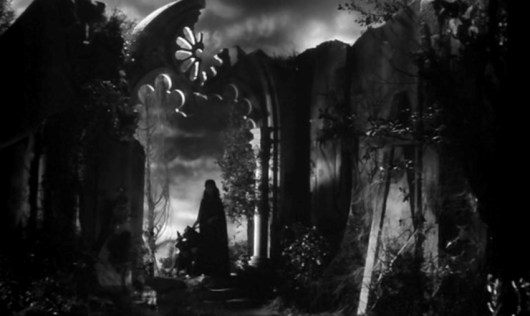
Mario Bava’s first directorial credit really stands the test of time as an (occasionally flawed) masterpiece of gothic horror. It exists in an interesting space between the old Universal classics of the 30s that preceded it and the rougher terrain the genre would come to tread over the course of the next couple decades.  If you’re looking for spooky old castles filled with cobwebs and riddled with secret passages, it’s got you covered. If you want to see a hot brand burning flesh, it’s got that too.  How about a carriage eerily racing through moonlit fog in slow motion? A giant bat attack in a ruined crypt? A young girl fearfully running through a dark forest, the spindly branches of trees seeming to reach out as if to grab her? This is your movie.  But what if you want needles being driven through eye sockets? The face of a loving father melting in a fire? A shambling corpse bursting out of wet earth? A spike filled metal mask being sledgehammered onto a witch’s face? But of course, Black Sunday, all things to all people, is there for you as well.

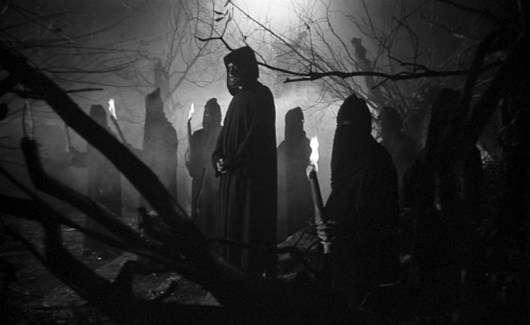
The story begins with a prelude set in Moldavia in the 17th century, two hundred years before the main action of the film. Princess Asa Vajda (Barbara Steele) is a witch (or possibly a vampire—the film plays fast and loose with its supernatural terminology) being ceremonially put to death by a robed and hooded inquisitorial mob for her wicked deeds, along with her brother and consort, Javuto (Arturo Dominici).  She is branded as a witch and a “Devil’s Mask” is hammered onto her face before she is set on a pyre to burn.  A storm prevents the job from being completed, but she is entombed in a coffin with a glass lid so that she can always see the cross above, which should theoretically keep her evil contained.

And so it does until a couple hundred years later when two doctors on their way to a conference happen upon her tomb, accidentally shatter the cross, break the glass atop her coffin (leading to a scratch on the hand that gives her a resuscitating drop of blood), steal a religious artifact that had been placed on her (it may have been helping to hold her down, but will also provide a useful user manual to defeat her later), and remove her Devil’s Mask (with some effort—it had been nailed on quite forcefully).  Then, having done everything wrong they possibly could, they have a chance meeting with the local princess (bearing a striking resemblance to the witch) whose family crypt they’ve been defiling and make their way to an inn for the night.

Said princess is Katja Vajda (also Barbara Steele), Asa the witch’s descendent, who has just turned 21 and is feeling some unnamable dread whose source she cannot identify. Long story short: Asa raises Javuto, has him kill and basically make vampires of one of the doctors, Katja’s father, and a few household servants, all so that Asa can steal Katja’s youth, beauty, and ultimately her life. 

Fortunately (I suppose), the younger of the two doctors and the inevitable romantic lead, Dr. Andrej Gorobec (John Richardson), teams up with a local priest to fight the vampires (dispatched by driving a spike through the left eye rather than a stake through the heart), defeat the witch, and save the girl (who has a real fainting problem—it’s a good thing she ends up with a doctor).

Bava based the story on a Nikolaj Gogol story, “Vij,” which I understand was far more faithfully adapted in the Russian film, Vij (another great movie). Here, the main points of connection seem to be the dark spookiness and folkloric quality of Eastern Europe, a witch, and, based on my viewing of the Russian film (not having read the Gogol), some kind of supposedly learned men who are actually quite useless. But the distance between source text and film is inconsequential.  This is Bava’s film, not Gogol’s, and as a piece of visual storytelling, it is significant.

On a compositional level, Black Sunday is decidedly effectual.  The lighting here is key—stark, casting heavy shadows in all directions, and creating striking looks throughout. In an early scene, the innkeeper’s daughter is sent against her wishes through the woods at night to milk the cow (who, for some reason is kept far from home, in a barn directly next to the cemetery where Javuto was interred beneath unholy ground and is now due to rise).

As she makes her way, terror-stricken to this ill-placed shed, she appears somehow lit from below, such that her face seems to be this one point of light and the darkness seems to close in on all sides.  It isn’t realistic if you stop to consider it, but it succeeds in evoking a very active darkness and her fear is contagious.  The camera frames spaces claustrophobically; the elegant clutter of a palatial manor or the shattered remains of coffins in an abandoned crypt are both used to create a sense of an invasive space. Elements that surround figures seem to move in on them, as with the darkness and creeping branches hunting the dairy seeking adolescent.   

In addition to being Mario’s progenitor, Eugenio Bava was also known as the father of special effects photography in Italian cinema, and his son carries on the family business admirably here.  By today’s standards, some of these effects might look a bit obvious, but in 1960 they were apparently truly shocking (the film was heavily edited when released in the States and was banned for years in the UK before the edited American version was allowed to be released) and some of them still offer a visceral kick in the 21st century.  When the Devil’s mask is hammered onto Asa’s face and blood spurts out, or when a spike is driven through the ocular socket of a sleeping vampire with a sickening squelch (followed by the priest delicately wiping his hand with a handkerchief) , even a modern horror viewer, well inured to viscera, might still find themselves cringing a bit with appreciative disgust.

And there are some truly arresting sequences, such as a frightening scene in which Katja is hounded by some unseen menace that appears to chase her through the castle, upturning everything in its path as she shouts for help. Finally, she comes to her father’s room, where he still lies, recently dead, awaiting funereal rites. We know that he has been turned and that the sun is about to set, but she has no inkling of what’s about to happen. She falls on his berth, calling out for his support in the face of the horrors that beset her and as she lowers her head, the light can be seen disappearing from the sky. It’s a delicious moment. If only it didn’t result in her fainting again, but you can’t have anything.

The only thing that really stands out as unsuccessful is a romantic subplot between Katja and Gorobec. They’ve known each other for perhaps 36 hours by the end of the movie and it’s a big leap of faith to go along with their relationship.  It doesn’t help that the dialogue is so very over the top.  A certain degree of verbal extravagance is welcome in such a film when it pertains to vengeance and undying evil, but an otherwise milquetoast love scene featuring such florid text as, “Even if all Mankind abandons this castle, or even deserts these grounds, there is no reason why you should do likewise with your life and your youth” is just a little hard to buy. 

Though, honestly, the language of the film plays better when watching it dubbed in Italian with English subtitles, rather than having to hear these clunky lines spoken in English (as with all Italian horror of this time, it was filmed without sound and all voices were dubbed later for different markets, often utilizing multi-national casts with each actor speaking their own native tongue).  But these are small gripes in the face of the total effect of the film.

I don’t know that there is much to read into the story of the film itself.  The witch is bad. Her victims are good.  In the end, love triumphs and the dead die once again.  The sun will shine.  But in its simplicity, it well houses an effective and historic horror piece that honors what came before it and prefigures what was soon to come.

I read too: Tales of Dungeons and Dragons (1986)

So, for some time, I’ve been meaning to finally write a post to justify having a “Books” button on the sidebar.  Therefore, I’d like to present Tales of Dungeons and Dragons, an anthology of short stories edited by Peter Haining.

Now, with a title like this, one may imagine ‘dungeons’ or ‘dragons,’ or something originating from Gary Gygax,  or at least some degree of high fantasy, but really, this is more of a horror collection than anything else, with the cover being the only connection to that expectation.  Inside, you’ll find 30 stories, grouped into three parts: Part I – The Sealed Section: Tales of Horror; Part II – The Ghost Section: Tales of the Supernatural; and Part III – The Wonder Section: Tales of Fantasy. Among many others, it collects stories from such luminaries of the dark fantastic as Bram Stoker, Edgar Allen Poe, Robert Bloch, Stephen King, M.R. James, Algernon Blackwood, H.P. Lovecraft, and Ray Bradbury.

The whole volume is solid and generally worth one’s time, if one is up for a certain earlier era of writing.  As it’s not feasible to delve into the whole book, I’d like to focus on three stand-out tales. Each of them in some way surprised me (a good way, a bad way, or an other way) and has lingered in the mind in some fashion. Let’s begin with the most fun.

The Dualitists (1887) by Bram Stoker

Written ten years before Dracula, this story is honestly shocking.  Really. I don’t think I could duly prepare you for it without spoiling the tale entirely.  With an older film, I don’t worry about spoilers, expecting that a reader of this blog has had a pretty fair chance to have seen some much-discussed genre classic, but in this case, I expect few have read this so I want to tread carefully. Suffice it to say, it is suggested only for those with a particularly dark sense of humor.

Also, it is very much in the public domain, so here’s a link to check it out for yourself, but don’t say I didn’t warn you.

I think this is a special one.  Written in a very literary, almost archaic style, its pretensions of class belie its wicked, impish desire to shock.  Here, with deepest irony, we follow the adventures of two ‘heroic’ young boys who set out to perfect their chosen art. This art just happens to be more than a bit destructive.  Perhaps the most fascinating feature here, besides a brutality you might not expect from a pre-twentieth century text not written by de Sade, is the way that its young heroes are always described in such shining, heightened terms.  Despite the extremity of their actions, Harry and Tommy are never characterized as anything other than brave, adventurous juveniles, engaged in an exciting and daring effort:

“The minds of these youths were of no common order, nor were their souls of such weak nature as to yield at the first summons of necessity. Like Nelson, they knew not fear; like Napoleon, they held ‘impossible’ to be the adjective of fools; and they reveled in the glorious truth that in the lexicon of youth is no such word as ‘fail’.”

And so, the effect is all the greater when you start to realize where they are going.  A dread grows as they move towards the apex of their artistry. And even though I could see the direction the story was taking, I was wholly unprepared for how totally it would go there.  The horror lands, but it does so with the unstifled guffaw of disbelief at its extremity.

I hope I’m not overselling it.  Anyway, maybe check this one out.  Maybe.  

The Eighty-Third (1916) by Katherine Fullerton Gerould

So whereas the first story was shocking in a very successful and enjoyable way, this next one brought a different manner of jolt.  And not a pleasant one.

First, it must be said that the writing here is effective and the story telling works.  A picture is clearly painted and the tension, fear, horror, and anger of the protagonist is stark and striking.  The narrative does suffer from a common pattern in horror fiction of situating its main character as a mere witness to horrors with little power to affect the course of events, but that lack of agency is part of the horror as well.  So I can say it is generally good, effective horror writing.

But ye gods, it is so very, very, very racist.

Just as Stoker’s piece was shocking in its extremity, this tale left my jaw on the floor in just how ugly its sentiment is.

Ok, so here’s the story and though a full text may be available out there, I don’t feel the need to link to it. Look it up if you like.

Published in 1916, this tale assumes that World War I would end one year later, but that the war to follow would be the one to really end human civilization. This story takes place during that next war. The narrator is a citizen of one of the few remaining neutral countries and is trying to work his way through war-torn lands to pass a border into temporary safety.  Along the way, he hears tell of some nightmare regiment called “the eighty-third.”  No one can agree about what it is and why it is so horrible, but it is generally known that it only travels by night, and that it is somehow wrong.

One night, taking shelter in a shack on the edge of a village, the narrator wakes to discover a local peasant woman hiding with him, driven there by the coming of the dreaded eighty-third.  She summarily faints in fear and he fearfully watches through a crack in the wall.

This gets ugly. Basically, the eighty-third consists of a multi-ethnic collection of disfigured soldiers who are carted from village to village by the conquering force to use rape as a weapon of war, such that “those who did not go the clean, cruel way of death should be defiled past hope.” The narrator observes these assaults being carried out in cold, calculated fashion, his gun pointed at the unconscious peasant woman should their location be discovered and he have to spare her the horror.

Finally, they pass and he continues on his way, sharing what he has seen and building to a multi-page diatribe about how the white man is an endangered species and bemoaning the end of all things.

Yeesh, right?

I debated writing about this one. I suppose I did because it is noteworthy how seemingly uncontroversial this text was. When published (in Harper’s Monthly, a reputable magazine), it was reportedly much lauded, one of the most popular short stories of the year.  One prominent critic called it “the most completely realized study of horror that American Literature has produced since The Fall of the House of Usher.”

Ok, but that was more than 100 years ago. This kind of material wouldn’t fly today, or at least wouldn’t go unremarked on, right?

Well, this collection was published in 1986. Only thirty five years ago. Now, it’s not that I’m necessarily appalled by its inclusion. As I’ve already written, it is a very successful horror story and probably of historical interest, an artifact of its time and place.  What blew me away is the fact that in the introduction to Gerould’s racist tract, its vile nature is entirely unengaged with. 

I’m not one to ‘cancel’ things, but I can’t imagine anthologizing this text without some kind of contextualization, simply presenting it rather, as one more great story.  Here’s a story about a vampire. Now, here’s one about a ghost. Now here’s one about the coming horde of non-white peoples who will defile all the white ladies.

I don’t recommend the story per se, but its existence, and it having been held in a place of some honor, is of some note.

The Lighthouse (unfinished/unpublished) by Edgar Allen Poe (sort of)

Having loved his 2015 film The VVitch, I was stoked to see Robert Eggers’s 2019 follow up, The Lighthouse, and it did not disappoint, leaving me giddy and delighted, with a sea shanty in my heart.  I’m bound to write about it at greater length in these pages before too long.

So, I was quite excited to discover that this odd collection contained Poe’s last, unfinished story, upon which the film had been based, but I had never read. Or at least, a posthumous collaboration between Poe and Robert Bloch who, 6 years before penning Psycho, was commissioned to finish Poe’s manuscript. It was an interesting and intriguing read, and I continually wondered at what point Bloch had taken over.

In summary, the story takes the form of diary entries by a man who has come to serve as a lighthouse keeper. Alone. Already it doesn’t seem like a great idea, but it is his most fervent wish to have time to himself to work on a piece of writing of some import.  It’s mentioned at one point that he’s supposed to be here for one year (which is hard to imagine), but by the end of the first week, he’s already going mad and by the end of the first month, our story has reached its end.

I first read this one during the first lockdown of the Coronavirus times and it was rather appropriate.  There are some things that seem relatively easy, even pleasant at first, that can quickly sour.  I particularly appreciate a passage where he writes of how hard it is to turn himself towards the book he’s meant to write.  He has all the time in the world, but he can’t do it.  I think that would ring true for many a creative type locked in their apartment for the last year:

“I seek to write – the book is bravely begun, but of late I can bring myself to do nothing constructive or creative – and in a moment, I fling aside my pen and rise to pace, to endlessly pace the narrow, circular confines of my tower of torment.”

Who hasn’t been there?

Finally, it builds towards a climax that I was certain could not have originated with Poe. I don’t want to give too much away, but the presence of a certain vampiric shark lady (who, sure, may have been a product of madness, but still…) materializing out of a storm before being fought off by the narrator’s faithful dog just seemed somehow less Poe-ish.

So then I worked my way back through the story, trying to determine where lay Poe’s final lines. I had some theories, but looked it up to check…

Out of a 14 page story, he had written the first 1.5.  Of course, Fantastic, the magazine where this version had first been published, made little mention of this fact when heralding “a new Edgar Allen Poe masterpiece.”

Basically, Poe wrote of the keeper coming to the lighthouse and being pretty happy to have some time to himself. The only hint of trouble was the final line of day three, in which he noted that the foundation of the building seemed to be made of chalk.  The next day’s entry was blank.

It’s unknown if this was to be continued as a short story, fleshed out to a novel, or if perhaps this was the whole piece, and that it just ends abruptly and enigmatically, suggesting that things will not go well. Either way, this was an interesting exercise. I think it might be fascinating to even have a whole anthology of different authors completing the text in their own way—doing justice to his suggestions, his style, but then branching off in their own directions.  That could be a book worth picking up.

Anyway, the building dread and madness are characteristically enjoyable and the fish lady was a real surprise.