So, I missed a week there. Sometimes life gets busy and it is simply not possible to keep up with my self-imposed weekly schedule. But it was for a cool (though entirely non-horror related) reason. The cabaret I work with in Kraków, Poland had an opportunity to give a few performances in Lyon, France last weekend, which was intense, exhausting, rewarding and more than a little time consuming (17 hours of driving each way to transport costumes and some small scenic elements). And so, I thought I would honor my little French sojourn by rewatching something French, Georges Franju’s stunning, poetic, and shockingly gory for 1960, Les yeux sans visage, A.K.A., Eyes Without a Face.
Eyes Without a Face (1960)
But here’s the thing. I really loved this movie when I first watched it a few years back, but three days after returning from France, I hopped on a plane to the States to come help my family prepare their summer show, and so I ended up revisiting Eyes Without a Face on my phone on the plane, exhausted, with limited cognitive abilities. It was far from an ideal viewing situation. And now, I find myself jet lagged and struggling to come up with anything particularly incisive to write about it. So I’ll keep this short.
Apparently, Franju, who had won acclaim as a documentarian and puzzled/disappointed French critics with this transition to a genre film, had to navigate some choppy seas to appease various censors in adapting the novel by Jean Redon. To satisfy the French, the gore had to be curtailed. To satisfy the English, scenes of experiments on animals had to be greatly reduced, and oddly, to satisfy the Germans, the key element of a “mad doctor” had to be softened. One solution Franju struck upon was to center the film more on Christiane, the daughter whose face had been so disfigured in an accident rather than her father, Dr. Génessier, a surgeon obsessed with perfecting the skin graft that will allow him to give her a new one, stolen from one of the girls he and his assistant periodically kidnap and murder. In focusing on Christiane, the film adopts a haunted, sorrowful tone, dwelling more on her lonely, doomed life as a caged bird, than on the extremities of her controlling father, so driven to fix her, to perfect her, who after afixing a stolen face, instructs her to “Smile. Smile! Not too much…”
The result is a sometimes jarring, often wistful, haunting little masterpiece, which reportedly shocked audiences upon release. While the most gory elements may have been omitted, the surgery scene in which a girl’s face is cut off is rather effectively gross, multiple scenes of Dr. Génessier’s assistant, Louise luring some girl to her doom are quite disturbing, and some sequences, such as a girl awakening to find herself strapped to a table, prepped for unwilling surgery (not to mention the other girl who awakens to find herself faceless and wrapped in gauze), or the father being eaten by the dogs on which he had been testing his new skin graft techniques, are respectively terrifying and brutal.
The cinematography is gorgeous, the music is odd, and unsettling (notably the mad, circus like soundscape that accompanies Louise when she’s hunting for a new girl or disposing of a body), and the imagery is truly indelible. Throughout most of the film (except for when a new face has been grafted on, which will inevitably go necrotic and have to be removed, the graft technique not yet perfected), Christiane wears a featureless mask, granting her a seeming gentle peacefulness so unlike the sorrow that fills her. The mask itself, in its simplicity, is striking and was even apparently an inspiration for the original Michael Meyers mask in Halloween. It is beautiful in its way, but it is also a cruel imposition, denying her own identity, her own experience and pain.
Frequently, she removes it, only to be told time and time again that she must develop the habit of wearing it always. She is not allowed to feel her sadness. She is not allowed to be her disfigured self (perhaps because her father was responsible for her state, as he had been driving and caused the accident with his recklessness – if her deformity is unseen, he has done no wrong), and her father’s attempts to heal her would actually result in her ultimate disappearance; another girl has been buried in her place – she is dead to the world – if the surgery is finally successful, she would have another person’s face, would have to accept a new name, would have to take on a new identity, merely the creation of her father, her own self lost to the process.
In the end, faced with yet another poor girl strapped to a table, Christiane opts to free her, herself, and all the animals her father keeps as pets/decorations/experimental subjects. The dogs escape and tear him apart and, adorned with white doves and faceless, Christiane slips off into the night, finally free and alone, and herself. It is lovely, and sad, and it lingers in the memory. And yet, for all its poetic beauty, the film was derided across Europe and particularly in France. I can’t imagine it was all that well received in the States, where, among other things, the key facial removal scene was excised, and yet it was marketed under the B-movie title, The Horror Chamber of Dr. Faustus and packaged as a double feature with a two-headed creature feature called The Manster. French critics were appalled at the crass horror of it all, and I imagine that American audiences who went to the drive in for some schlocky fun were nonplussed by the tender, artful misery on display – for lack of a better word, its Frenchness.
But it really is something special. My brain is running low at this point, so I don’t know that I have anything more illuminating to add, but if you haven’t seen this, I recommend giving it a chance. Eat some cheese, drink some wine, and watch the classiest face stealing movie you’re ever likely to come across.
When you consider the things that scare people, some are obvious and some are not. Though most spiders and snakes won’t bite you, some can kill and it’s hard to know which is which. Though standing at a great height on a windless day, there is no reason to think you might fall, if you did, it would be fatal. Though most of us will probably never be stalked by a madman with a knife, that would certainly be unpleasant and we could be forgiven fearing such a thing. But then there are some fears that seem less rooted in realistic threat: open spaces, for instance, or public speaking, or a doll, or a clown.
I think films like Child’s Play or Puppet Master work because toys should be safe. They exist only to entertain children and therefore, carry a de facto innocence. They are in our homes, with our kids, and we trust them, but trust necessitates vulnerability and maybe that’s scary. So if they happen to carry the spirit of a serial killer or have been animated by an ancient Egyptian spell, and come to life in the middle of the night to prey on our children or ourselves, beyond just being a danger, the corruption of the trusted, innocent plaything lends an additional sheen of horror, of wrongness.
So, too with clowns, a common fear. Again, they exist to make kids happy, but their image inherently suggests that something else might lie beneath the façade of a painted smile. Thus, it’s not that surprising that, while most might be perfectly nice children’s entertainers, the monstrous clown, grotesque beneath the greasepaint, has become a common image of fear.
And if these markers of innocence, these things that become horrific because it’s wrong for kids’ things to be scary, if they can send chills down the spine, what about kids themselves? I doubt I’m alone in thinking they too can be eerie. They are human, but they’re not really like us – and are thus somewhat alien. They come from us and we try to “raise them right” to share our values and perspectives, but they retain their interiority and we can never really know what’s happening behind their eyes. We love and protect them, treasuring their innocence for as long as it lasts, but we also know that they can lie, and take, and act out of a wrathful, violent sense of having been wronged. I read somewhere that every two-year-old is essentially a psychopath, but that most of us grow out of it. I’ve never been a parent, but I can imagine it’s a terrifying thought that yours might not.
And so, with that, I’d like to look at two films today that offer iconic treatments of the creepy child: The Bad Seed and Village of the Damned. To really discuss them in some detail, there will be spoilers so I recommend seeking them out before going any further.
What Is It With Overly Mature Blonde Kids?
There are many currents that run through both works, some of which are surface similarities and some of which speak to a deeper resonance. In both cases we have creepy children with flaxen hair, who can be unnervingly adult in their demeanor, whose threat is linked to their heredity, who kill remorselessly to get what they want, and whose parent figures take it upon themselves to kill them. I think in both films, the creep factor is linked with this sense of a maturity beyond their years. For a child to be cold and calculating, to enact its own gaze, declaring itself a subject of equal or greater prominence as the adults around it, can be unnerving. Rhoda is often praised for her maturity, but sometimes her mother seems uncomfortable with it as well. The children of the village are never demure minors to be watched by their elders – they look back and with their look, they actively use their power, controlling people’s minds and bending them to their will.
We also have an interesting treatment of sociopathy in both cases, but they do differ in significant ways. Rhoda is described as a “natural little girl” who “knows what she wants and asks for it – not like these over-civilized little pets that have to go through analysis before they can choose an ice cream soda.” Unhampered by social mores, she unashamedly voices her desires and does what she needs to in order to realize them. If this means murder, that is no bother to her and she feels no guilt; after all, she wanted it, now she has it, and she’s not the one who drowned so why should she be upset? The children are also free from remorse, and it is there that their alien potency lies. In their words, “If you did not suffer from emotions, from feelings, you could be as powerful as we are.” It’s not only mental dominance, but rather this amoral freedom that gives them an edge. And in both films, their parent figure futilely tries to instill a moral sense, only to come up against a brick wall (though said wall becomes quite useful in the second film). Much of the horror of both films is the realization of the impossibility of that moral instruction. They are simply different and cannot be shaped by a ‘good upbringing.’
The Bad Seed (1956)
Based on a book, and later a play, of the same name, Mervyn LeRoy’s film is high family melodrama of the first order, and it is a treat. At its center is Christine Penmark, the mother of a young girl, Rhoda, the titular “bad seed.” Having grown up with loving and doting parents, and then loving and doting on a child of her own, Christine has always feared somehow that she was adopted. After noticing concerning behavior from her daughter, she presses the issue and learns that she had been born to a famous serial killer. Somehow this penchant for killing skipped her generation and has been planted in her beloved eight year old child, a child whom we know is responsible for at least three murders and by the end of the film is unashamedly planning a fourth. Christine poisons Rhoda and subsequently shoots herself in the head (in the first of three endings in the film – it had trouble with the Hayes Code and had to do some narrative gymnastics to secure a release). It is an emotional, intense film and the confrontation with a horrific truth, long dreaded and now impossible to deny, situates it in the genre even without the presence of a creepy killer kid.
Central to the story is the classic question of Nature vs. Nurture. The film is peopled with psychologists, crime journalists, and writers, and they are generally all of the opinion that the results are in and that environment alone shapes personality – a child from a good home, well raised, simply could not become criminal – it is only the socially and economically deprived who fall into a life of crime. The idea that a child could be born with such murderous inclinations is simply beyond belief. Thus, as Christine comes to this reckoning, she is alone in it and her concerns fall on deaf ears. I think in this, the story circles around issues of class in an interesting manner. It is clear that Christine comes from money (particularly in contrast to the Daigles, the parents of Claude, the child Rhoda kills), and it is unthinkable that a child of her station could commit a crime – that is something that only poor children do. Now, is the film’s stance progressive in showing how this villainy can grow even in the richest soil, or is there an ugliness in the suggestion that ‘bad blood will out’? After all, it is because Christine’s mother was a killer (from lower circumstances) that her daughter is doomed to be one as well. It is of central importance that Rhoda’s moral deformity is not just a question of happenstance, but rather of heredity.
The main thing that distinguishes this from today’s other film is how emotional it is. Christine is so distraught by Claude’s death and it is so shocking when Rhoda isn’t. Christine is confronted with the weight of that loss by Claude’s mother, Hortense (Eileen Heckart, who rather steals the show as the drunk, broken mother, with nothing left to lose, gasping for the truth). The juxtaposition of Rhoda happily banging away Au Clair de la Lune on the piano as Leroy burns to death on the lawn is chilling and the choice to focus solely on Christine’s face through the sequence is heartbreaking – she knows whose responsibility this is – hers. And ultimately, the revelation of Christine’s birth is a source of great trauma, and the degree to which she is tragically torn between the need to protect her daughter and to destroy the evil she has spawned is powerful. When she finally decides to give Rhoda an overdose of sleeping pills (which she happily gobbles up as a new vitamin), it is to protect her from a world which would hunt her as a monster. It’s all very effective and it’s a shame that the censors of the time forced the adoption of such a bizarre ending (which I won’t describe, but is fun in its sudden, out of left field, over-the-top ridiculousness).
Even with this oddly tacked on final moment, the total effect is enjoyably melodramatic and tragic, and it’s got a real bite.
Village of the Damned (1960)
The second film is also concerned with emotion, but more as a study of its absence. While Rhoda can be calculating, she also has a psychopath’s rage. In contrast, the children of the village are totally distanced from emotion, and this remove makes them uncanny. Furthermore, taking an unemotional, scientific approach is what distinguishes the main protagonists as well.
The story begins with a strange and intriguing occurrence. One day, everyone within the border of Midwich, a small British village, falls unconscious. In response, a military team investigates methodically, setting up a perimeter, seeing what happens when someone new enters (they pass out as well), and testing everyone when all is said and done. One moment sets the tone for the rest of the film. Major Bernard, unable to reach family in Midwich, goes to investigate. When nearing the town line, he sees a police officer enter to check out a crashed bus and immediately collapse. He doesn’t run in after him or try to help him at all, but immediately turns around and drives the other way to call in the authorities. What a reasonable thing to do.
It’s soon discovered that every woman of child bearing age is now pregnant (a fact resulting in some heightened emotion – both good and bad as some husbands have been away on work or some teens have never even kissed a boy) and those pregnancies develop rapidly, resulting in a batch of eerie, platinum haired babies all born on the same day, who can telepathically communicate with each other and have some power of command over others. We largely follow Gordon Zellaby, an older man with a young wife who finds himself the supposed father of one of these children. A man of science, he does not seem overly bothered by his lack of true paternity, but is thrilled at the possibilities the children may lead to: “they are one mind to the twelfth power. Now just think what it would mean if we could guide it…we cannot throw away this potential just because of a few incidents.”
Others in the town, in the government, or in other countries where this strange event also occurred are made uncomfortable by the kids, and in some countries we learn that the children, and even sometimes the mothers, were all killed (in the USSR, the whole city where they lived was nuked because they had taken control and there was no other way to stop them). However, Gordon defends their value to science and human progress, establishing a school that they will all be moved into, where he can try to teach them, instilling human values of empathy and kindness.
In the end, he comes to understand the threat they pose to humanity at large (planning to spread and start new colonies), he calmly sends his wife away under some pretense, and managing to block them out of his mind, he goes for his final lesson with a bomb in his briefcase and blows them all up. While The Bad Seed chews the scenery at every opportunity (delightfully so), this films plays it cool, and that is perhaps its central theme. The children’s lack of passion, of affect is both troubling and powerful. They are more open to Gordon than some others because he is able to approach them from a position of scientific curiosity and not outrage, and in the end, he defeats them by acting in a precise, calculated manner. It’s even easy to miss his change from their defender to their killer, and when I first watched it, I found that to be a flaw – something was missing.
While the first half had been so intriguing, in the second half, as we moved towards the climax, it was all so cool – where was the drama of this final decision? But on reflection, it is fitting that his was the only possible solution. The angry villagers with pitchforks and torches were immediately rebuffed and/or burned to death. The scientist who has simply made a reasonable decision and who goes to carry it out in a dispassionate manner can successfully mask his intentions and carry them to completion, thus saving the town, and possible the world itself. It is not that he lacks emotion (he seems to love his wife, had been initially quite happy at the prospect of parenthood, and played the piano wistfully waiting to go off and explode), but he can act without it, and thus triumphs.
What’s Worse – Fire or Ice?
While Rhoda lacks empathy or true tenderness, she experiences passions. She wants, and demands, and takes hotly, lashing out when not accommodated. The children of Midwich are rather the opposite, acting only out of a calculated biological drive to live and to spread. They do not rage or feel wronged; they do just that which is necessary. And which of these is really the larger threat?
In both cases, morality and ethics are absent. Neither cares about how others feel or what they think. But one is hot, chaotic, and probably far easier to identify with – we all get angry sometimes, feel wronged, want to have what we want when we want it – and the other is cold, reasonable, and organized. For my part, Rhoda is scariest in a personal sense – we know that the world is full of jerks and egoists who only care about themselves, and we constantly have to interact with them (though hopefully none of them will burn us alive, drown us, or push us down the stairs). Furthermore, the horror of a child being so irredeemable is really awful. But the children of Midwich represent something much scarier on a larger, necessarily impersonal, scale. In their uniformity and cold, functional intention, they are the drive of progress, of power, of the future, of any system or machine that cares not who gets crushed beneath its wheels as it moves inexorably forward. Do they have a whiff of Nazism in their Aryan appearance and drive to power and domination? Perhaps Rhoda is a more horrific person (because she is a person – a simplified perhaps, but well-drawn young sociopath), but the children of Midwich are a more chilling concept, especially since it probably can’t be forestalled by thinking of a brick wall: the future will come for us – it cannot be reasoned with – and it will break us.
But I’m sure your kid is great. A little angel. Nothing to worry about at all…
Sometimes there are those films that you really know you should have seen by now, but it’s somehow hard to finally pull the trigger on. This was one of those for me for the longest time and I’m so glad that a few months ago, I finally remedied the situation:
Black Sunday AKA the Mask of the Devil (1960)
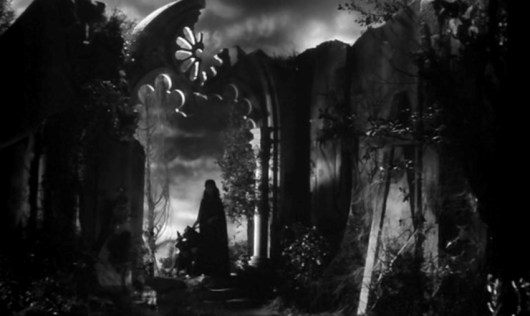
Mario Bava’s first directorial credit really stands the test of time as an (occasionally flawed) masterpiece of gothic horror. It exists in an interesting space between the old Universal classics of the 30s that preceded it and the rougher terrain the genre would come to tread over the course of the next couple decades. If you’re looking for spooky old castles filled with cobwebs and riddled with secret passages, it’s got you covered. If you want to see a hot brand burning flesh, it’s got that too. How about a carriage eerily racing through moonlit fog in slow motion? A giant bat attack in a ruined crypt? A young girl fearfully running through a dark forest, the spindly branches of trees seeming to reach out as if to grab her? This is your movie. But what if you want needles being driven through eye sockets? The face of a loving father melting in a fire? A shambling corpse bursting out of wet earth? A spike filled metal mask being sledgehammered onto a witch’s face? But of course, Black Sunday, all things to all people, is there for you as well.
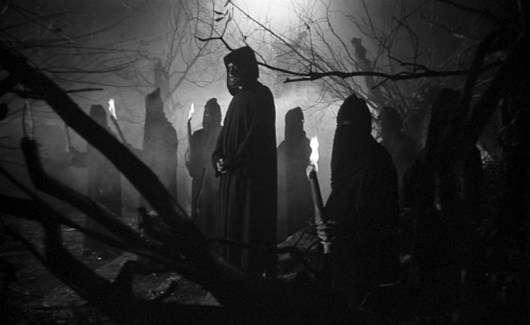
The story begins with a prelude set in Moldavia in the 17th century, two hundred years before the main action of the film. Princess Asa Vajda (Barbara Steele) is a witch (or possibly a vampire—the film plays fast and loose with its supernatural terminology) being ceremonially put to death by a robed and hooded inquisitorial mob for her wicked deeds, along with her brother and consort, Javuto (Arturo Dominici). She is branded as a witch and a “Devil’s Mask” is hammered onto her face before she is set on a pyre to burn. A storm prevents the job from being completed, but she is entombed in a coffin with a glass lid so that she can always see the cross above, which should theoretically keep her evil contained.
And so it does until a couple hundred years later when two doctors on their way to a conference happen upon her tomb, accidentally shatter the cross, break the glass atop her coffin (leading to a scratch on the hand that gives her a resuscitating drop of blood), steal a religious artifact that had been placed on her (it may have been helping to hold her down, but will also provide a useful user manual to defeat her later), and remove her Devil’s Mask (with some effort—it had been nailed on quite forcefully). Then, having done everything wrong they possibly could, they have a chance meeting with the local princess (bearing a striking resemblance to the witch) whose family crypt they’ve been defiling and make their way to an inn for the night.
Said princess is Katja Vajda (also Barbara Steele), Asa the witch’s descendent, who has just turned 21 and is feeling some unnamable dread whose source she cannot identify. Long story short: Asa raises Javuto, has him kill and basically make vampires of one of the doctors, Katja’s father, and a few household servants, all so that Asa can steal Katja’s youth, beauty, and ultimately her life.
Fortunately (I suppose), the younger of the two doctors and the inevitable romantic lead, Dr. Andrej Gorobec (John Richardson), teams up with a local priest to fight the vampires (dispatched by driving a spike through the left eye rather than a stake through the heart), defeat the witch, and save the girl (who has a real fainting problem—it’s a good thing she ends up with a doctor).
Bava based the story on a Nikolaj Gogol story, “Vij,” which I understand was far more faithfully adapted in the Russian film, Vij (another great movie). Here, the main points of connection seem to be the dark spookiness and folkloric quality of Eastern Europe, a witch, and, based on my viewing of the Russian film (not having read the Gogol), some kind of supposedly learned men who are actually quite useless. But the distance between source text and film is inconsequential. This is Bava’s film, not Gogol’s, and as a piece of visual storytelling, it is significant.
On a compositional level, Black Sunday is decidedly effectual. The lighting here is key—stark, casting heavy shadows in all directions, and creating striking looks throughout. In an early scene, the innkeeper’s daughter is sent against her wishes through the woods at night to milk the cow (who, for some reason is kept far from home, in a barn directly next to the cemetery where Javuto was interred beneath unholy ground and is now due to rise).
As she makes her way, terror-stricken to this ill-placed shed, she appears somehow lit from below, such that her face seems to be this one point of light and the darkness seems to close in on all sides. It isn’t realistic if you stop to consider it, but it succeeds in evoking a very active darkness and her fear is contagious. The camera frames spaces claustrophobically; the elegant clutter of a palatial manor or the shattered remains of coffins in an abandoned crypt are both used to create a sense of an invasive space. Elements that surround figures seem to move in on them, as with the darkness and creeping branches hunting the dairy seeking adolescent.
In addition to being Mario’s progenitor, Eugenio Bava was also known as the father of special effects photography in Italian cinema, and his son carries on the family business admirably here. By today’s standards, some of these effects might look a bit obvious, but in 1960 they were apparently truly shocking (the film was heavily edited when released in the States and was banned for years in the UK before the edited American version was allowed to be released) and some of them still offer a visceral kick in the 21st century. When the Devil’s mask is hammered onto Asa’s face and blood spurts out, or when a spike is driven through the ocular socket of a sleeping vampire with a sickening squelch (followed by the priest delicately wiping his hand with a handkerchief) , even a modern horror viewer, well inured to viscera, might still find themselves cringing a bit with appreciative disgust.
And there are some truly arresting sequences, such as a frightening scene in which Katja is hounded by some unseen menace that appears to chase her through the castle, upturning everything in its path as she shouts for help. Finally, she comes to her father’s room, where he still lies, recently dead, awaiting funereal rites. We know that he has been turned and that the sun is about to set, but she has no inkling of what’s about to happen. She falls on his berth, calling out for his support in the face of the horrors that beset her and as she lowers her head, the light can be seen disappearing from the sky. It’s a delicious moment. If only it didn’t result in her fainting again, but you can’t have anything.
The only thing that really stands out as unsuccessful is a romantic subplot between Katja and Gorobec. They’ve known each other for perhaps 36 hours by the end of the movie and it’s a big leap of faith to go along with their relationship. It doesn’t help that the dialogue is so very over the top. A certain degree of verbal extravagance is welcome in such a film when it pertains to vengeance and undying evil, but an otherwise milquetoast love scene featuring such florid text as, “Even if all Mankind abandons this castle, or even deserts these grounds, there is no reason why you should do likewise with your life and your youth” is just a little hard to buy.
Though, honestly, the language of the film plays better when watching it dubbed in Italian with English subtitles, rather than having to hear these clunky lines spoken in English (as with all Italian horror of this time, it was filmed without sound and all voices were dubbed later for different markets, often utilizing multi-national casts with each actor speaking their own native tongue). But these are small gripes in the face of the total effect of the film.
I don’t know that there is much to read into the story of the film itself. The witch is bad. Her victims are good. In the end, love triumphs and the dead die once again. The sun will shine. But in its simplicity, it well houses an effective and historic horror piece that honors what came before it and prefigures what was soon to come.
Used only with old Urchin versions of Google Analytics and not with GA.js. Was used to distinguish between new sessions and visits at the end of a session.
End of session (browser)
__utmz
Contains information about the traffic source or campaign that directed user to the website. The cookie is set when the GA.js javascript is loaded and updated when data is sent to the Google Anaytics server
6 months after last activity
__utmv
Contains custom information set by the web developer via the _setCustomVar method in Google Analytics. This cookie is updated every time new data is sent to the Google Analytics server.
2 years after last activity
__utmx
Used to determine whether a user is included in an A / B or Multivariate test.
18 months
_ga
ID used to identify users
2 years
_gali
Used by Google Analytics to determine which links on a page are being clicked
30 seconds
_ga_
ID used to identify users
2 years
_gid
ID used to identify users for 24 hours after last activity
24 hours
_gat
Used to monitor number of Google Analytics server requests when using Google Tag Manager
1 minute
_gac_
Contains information related to marketing campaigns of the user. These are shared with Google AdWords / Google Ads when the Google Ads and Google Analytics accounts are linked together.
90 days
__utma
ID used to identify users and sessions
2 years after last activity
__utmt
Used to monitor number of Google Analytics server requests
10 minutes
__utmb
Used to distinguish new sessions and visits. This cookie is set when the GA.js javascript library is loaded and there is no existing __utmb cookie. The cookie is updated every time data is sent to the Google Analytics server.